

Search Engine Scraping Services
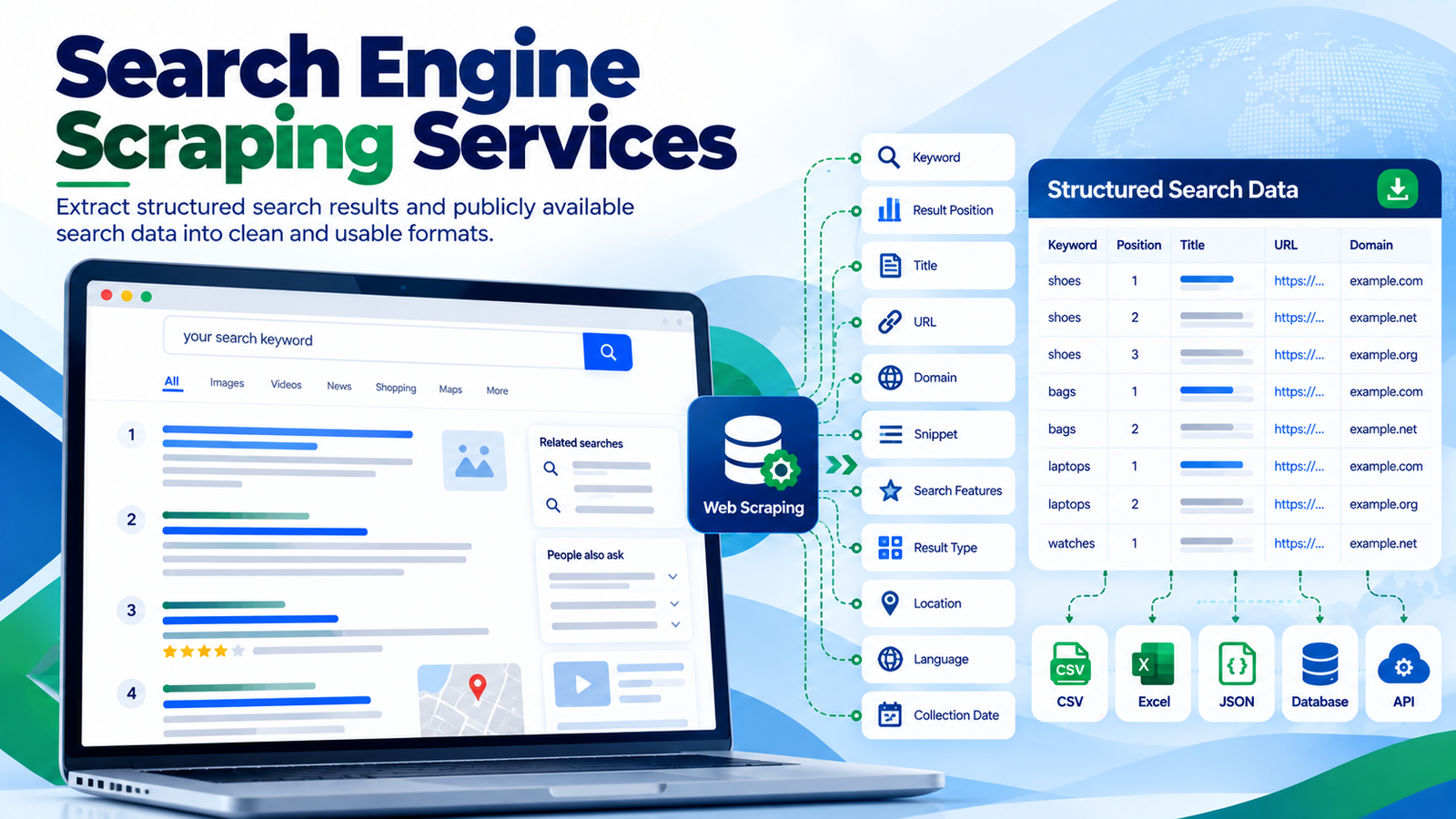
Search engine scraping services enable businesses to extract structured data from search engine results pages (SERPs) based on defined keywords, locations, languages, and search requirements.
Worth Web Scraping offers custom search engine data extraction services to gather publicly available search results and structure them into datasets. Depending on the project, the collected information can be the result titles, URLs, descriptions or snippets, rankings, displayed search features, and other information publicly available from the SERP.
The data can be used for SEO research, keyword research, competitor research, market research, search visibility monitoring and other business requirements.
What Is Search Engine Scraping?
Search engine scraping is the act of collecting publicly available information displayed on search engine results pages and transforming it into structured data.
Instead of manually checking hundreds or thousands of search queries, a customized scraping workflow can collect the required search-result information based on predefined keywords and project requirements.
A search engine scraping project can be built around:
- Keywords search
- Search engine
- Location/Country
- Language
- Device type if supported
- Result pages
- Frequency of search
- Data fields required
- Output format
The data that can be provided depends on the search engine, the query, the location and the source structure chosen.
What Can We Get from Search Engine Data?
Our search engine scraping service can be tailored to the fields needed for your project.
Data of Search Results
Data may include, depending on the source and project requirements:
- Search key
- Position of search
- Title of Result
- URL of result
- Show Description/ Snippet
- Source domain,
- Type of result
- Search by page number
- Location of search
- Language for search
- Date and time of collection
SERP Feature Data
Where technically feasible and publicly displayed, the project may include selected search-result features such as:
- Snippets Featured
- Associated search
- People Also Ask Results
- Knowledge panels
- Advertisements
- Community results
- Images results
- Video results
- Results news
- Shopping results
Availability and structure of these elements may differ by search engine, query, location, and time.
Search Engine Scraping for SEO Research Purposes
SEO teams often require search result data to see how websites rank for particular keywords.
Structured SERP data can help:
- Keyword research
- Search results analysis
- Competitor research
- Ranking of research
- SERP tracking
- Search analysis transparency
- Content research |
- Analysis at the domain level
- Comparisons of search results
- Creation of a historical dataset
For example, a project could gather the top search results for a given set of keywords and then classify the results by keyword, position, URL, domain, location, and date of collection.
Keyword research Search engine data
The keyword-based search data can give a structured perspective of the websites showing up for chosen queries.
To create a custom dataset, use:
Keyword Position Title URL Domain Snippet keyword 1 1 Result title URL example.com Description keyword 1 2 Result title URL example.org Description keyword 2 1 Result title URL example.net Description
This structure can make large keyword datasets easier to analyze and integrate with internal SEO or research work flows.
**Competitor Research (Search Engine Scraping)
You can also use search result data to find websites and domains that rank for specific keywords.
A competitor research dataset can include, depending on your needs:
- Competing domain
- Position in the rankings
- Keyword
- URL
- Page heading
- Search result snippet
- Frequency of search results
- Place
- Date Collected
This is helpful for research teams to organize search visibility information for large sets of keywords.
Local Search Result Info
Results for your search may differ depending on where you live.
Search data can be collected through defined, where technically permitted by the source and project scope:
- Nation
- State or territory
- Cities
- Post Code
- Language
- Location parameters other
This can be useful for projects that need to compare search results between different geographic markets.
Market Research Data from Search Engines
Search results also provide a structured source for market and industry research.
Businesses can gather search-result datasets around:
- Items
- Branding •
- – Firms
- Services
- Industries
- Place
- Subjects
- Competitors’ keywords
The data collected can then be combined with other publicly available datasets to provide wider research and analysis.
How We Scrape Search Engines
It is not enough to send search queries to collect data from a search engine reliably. The search parameters, source structure, required fields, volume and delivery format have to be defined beforehand.
The workflow could be:
- Definition of search requirement
You provide the search engines, keywords, locations, languages, result depth and other requirements. - Definition of Data Field
We define precisely which fields of the search result are to be collected. - Workflow of Scraping
The collection workflow is designed based on the selected search engines and project needs. - Collection of Search Results
Information of the search result which is publicly available according to the defined scope is gathered. - Organizing Data
The collected results are organized in uniform records and fields. - Data Validation & Cleaning
If needed, we can review duplicates, inconsistent formatting, missing values, and other defined data-quality requirements. - Data Deliverables
The final dataset can be provided in the format you require for your workflow.
search engine data scraping delivery
Collected SERP data can be structured for many downstream applications.
Available delivery formats may include:
- CSV file types
- Excel (Microsoft)
- JSON (JavaScript Object Notation)
- API Interface
- Data Base
The way you end things depends on your app, analysis workflow, dataset size, and project requirements.
These formats are already in your broader data-delivery offering, so using the same terminology here will provide consistency across your service pages.
One-time or recurring collection of search engine data
Different businesses have different data needs.
Single-time SERP data gathering
When you need a defined search result data set for:
- SEO investigation
- Market Study
- Competitive analysis
- Research keywords
Search Engine Data Collection Industry research (Recurring)
For projects that need to be updated on a recurring basis, selected search queries can be harvested repeatedly according to the agreed schedule.
Potential recurring datasets include:
- Revised search results
- Altered rankings
- URLs of the results
- Search snippets
- Features of search results • Date collected • Other selected areas
You can configure the frequency and scope to suit your needs.
Who is eligible for Search Engine Scraping Services?
Search engine data can be used to support various business teams and research needs.
SEO Companies
Collect structured SERP data for keyword and search result research.
Team Digital Marketing
Analyze search results for chosen keywords and markets.
Market Research Team
Create datasets for products, companies, industries and topics
Intelligence Teams Competitive
Research areas and pages shown for selected search queries.
SaaS and Technology Companies
Use structured search-result data in apps, dashboards, or internal systems.
Research Organizations
Collect and analyze defined search result datasets for reporting.
Why should you use custom search engine scraping service?
When you need to process large keyword lists, multiple locations, multiple search engines or recurring data sets, search result collection gets complicated.
A tailor-made service can help you:
- Reduce repetitive manual searches
- Build large keyword databases
- Standardize search result information
- Results combined from selected sources
- Input data into structured records
- Support ongoing data collection
- Prepare data for databases and applications.
- Get the data in the format you want
The exact scope depends on the search engines, keywords, locations, fields, volume and frequency you set for the project.
Custom Search Engine Scraping Solutions
Every SERP project has different needs.
We can customize the collect flow around:
- – Web search engines
- Keywords
- Depth of search results
- Locations
- Languages.
- Data fields
- Frequency of collection
- Volume of data
- Output Format
- Database or API requirements
Instead of giving a fixed dataset, the project can be built around what your business actually needs.
From Search Results to Structured Data
The overall workflow is shown below:
Search Queries → Search Engine Results → Data Extraction → Data Cleaning → Structured Dataset → Delivery
This way the information collected is easier to use for research, analysis, monitoring, applications and internal databases.
Privacy and Data Open to Public
We collect publicly available information according to the defined project requirements.
We do not collect or sell any data that we gather. In our current website policy we do not scrape personally identifiable information or identity related information. Any of the company names, trademarks, or datasets shown on the website are representative of the types of projects and inquiries we receive and are not representative of an intention or ability to scrape those entities.
Frequently Asked Questions
What is scraping in search engine?
Search engine scraping is the process of extracting publicly available information from search engine result pages and organizing it into data.
What can we learn from search engines?
Depending on the search engine and project requirements, data can be keywords, result positions, titles, URLs, domains, snippets, and selected publicly displayed SERP features.
Can I grab search results by location?
If the source and technical configuration permits the necessary geographic parameters, collection of search results for a specific location can be configured.
Can you scrape results for thousands of keywords?
Large keyword datasets are available for custom projects. The way we collect depends on the keyword volume, search engines, locations, results depth, frequency, required fields.
Can I export search engine data to Excel?
Yes. The data can be delivered in Excel, CSV, JSON, API or database formats, depending on the project.
Is it possible to regularly gather search engine data?
Yes. When the project needs to be updated from time to time, then periodic collection of search results can be configured.
Need Search Engine Scraping Services?
Let us know which search engine(s), keyword(s), location(s), data fields, volume and delivery format you require.
We can review your requirements and build a search engine data scraping workflow for your project.
Ask for a Search Engine Scraping Project