

Job Data From Defined Sources
Job portals, company career pages, and selected recruitment websites carry structured information about open positions. A project can be scoped around the specific sources and fields your requirement calls for, rather than treating every job site the same way.
Collection depends on the source and the project defined for it: selected job portals, defined recruitment websites, and the fields agreed for the dataset.
Request a Data Collection Project
What Job Data Can Be Collected
Depending on the source and project requirements, job data can include:
- Job title
- Company name
- Location
- Employment type
- Work mode (such as remote or on-site, where stated)
- Salary, where displayed
- Experience level
- Skills
- Job description and details
- Posted date
- Job URL
- Other publicly displayed recruitment fields
Which fields are available depends on what a given source publishes.
Job Listings as Structured Records
Each job posting can be represented as one record with a consistent set of fields, rather than a page of loose text. A job-level record keeps the same fields in the same place, listing after listing. That typically means source information, location, employment details, skills or experience, and dates, where a source displays them.
Job Market Data Across Selected Sources
A project may pull listings from more than one place at once: a job board alongside a company’s own career page, for example, or several recruitment websites covering the same region.
The sources, locations, and job categories are defined by the project. Coverage reflects the sources actually selected, not every job board or career page that exists.
Fields That Matter for Recruitment Research
Job & Company Information
Job title, company name, company URL, industry, and company description, where a listing or career page displays them.
Location & Employment Details
City, state or region, country, remote status, and employment type, for postings where those details are given.
Skills & Experience
Skills, qualifications, experience level, education, and responsibilities, as listed in the posting itself.
Salary & Other Displayed Details
Salary or salary range, currency, and pay period, where a source publishes that information alongside the listing.
Posted Date & Listing Information
Posted date, job URL, and category, where the source displays them alongside the listing.
Organizing Job Data for Use
Once collected, job listings are organized into a structured dataset for the format the project requires. Possible delivery formats include:
- CSV
- Excel
- JSON
- API
- Database
The final structure is defined around the fields, source requirements, and how the dataset will be used downstream.
One-Time and Recurring Job Data Collection
One-Time Collection
A single collection fits projects that need a defined dataset at one point in time. Common examples include:
- Job market research
- Recruitment research
- Competitor hiring research
- Job listing collection
- Employer or job posting research
Recurring Collection
Where job postings need to be checked again over time, the same sources and fields are revisited according to the schedule defined for the project, rather than as a single pull.
From Job Listings to Structured Recruitment Data
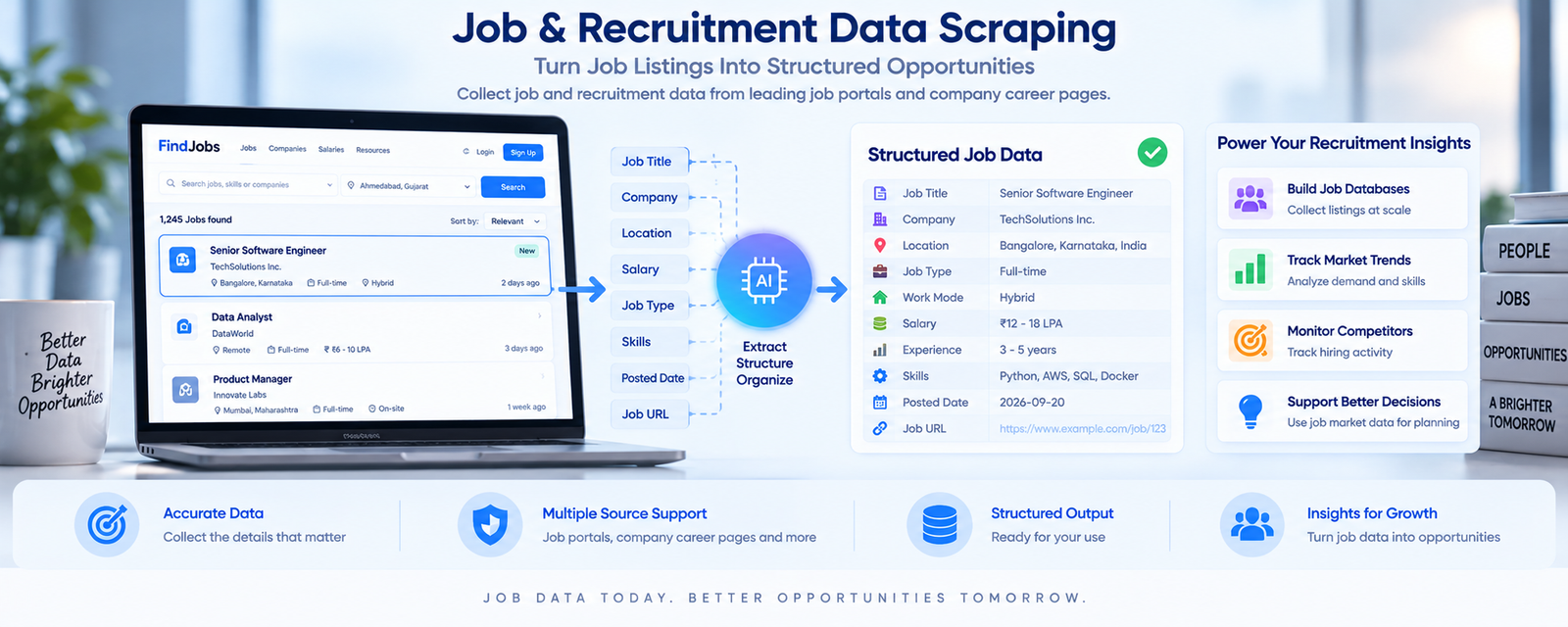
A single job listing can carry several distinct fields at once. The illustration below shows the types of fields that can be pulled from a listing like that and organized into a structured record. The company names, locations, salary ranges, skills, dates, and URLs shown are illustrative examples used to demonstrate the kind of data involved, not verified or current job data.
Job Data for Different Requirements
This type of project tends to support requirements such as:
- Job market research
- Recruitment research
- Employer research
- Hiring trend research
- Competitor hiring research
- Structured job databases
Define the Job Data You Need
Before scoping the work, it helps to define:
- Target job portals or websites
- Company career pages, where applicable
- Locations
- Job categories
- Required fields
- Whether the need is one-time or recurring
- Preferred output format
- Any source-specific requirements
Once these are defined, we can review the requirement and confirm an approach for the project.
Request a Data Collection Project