

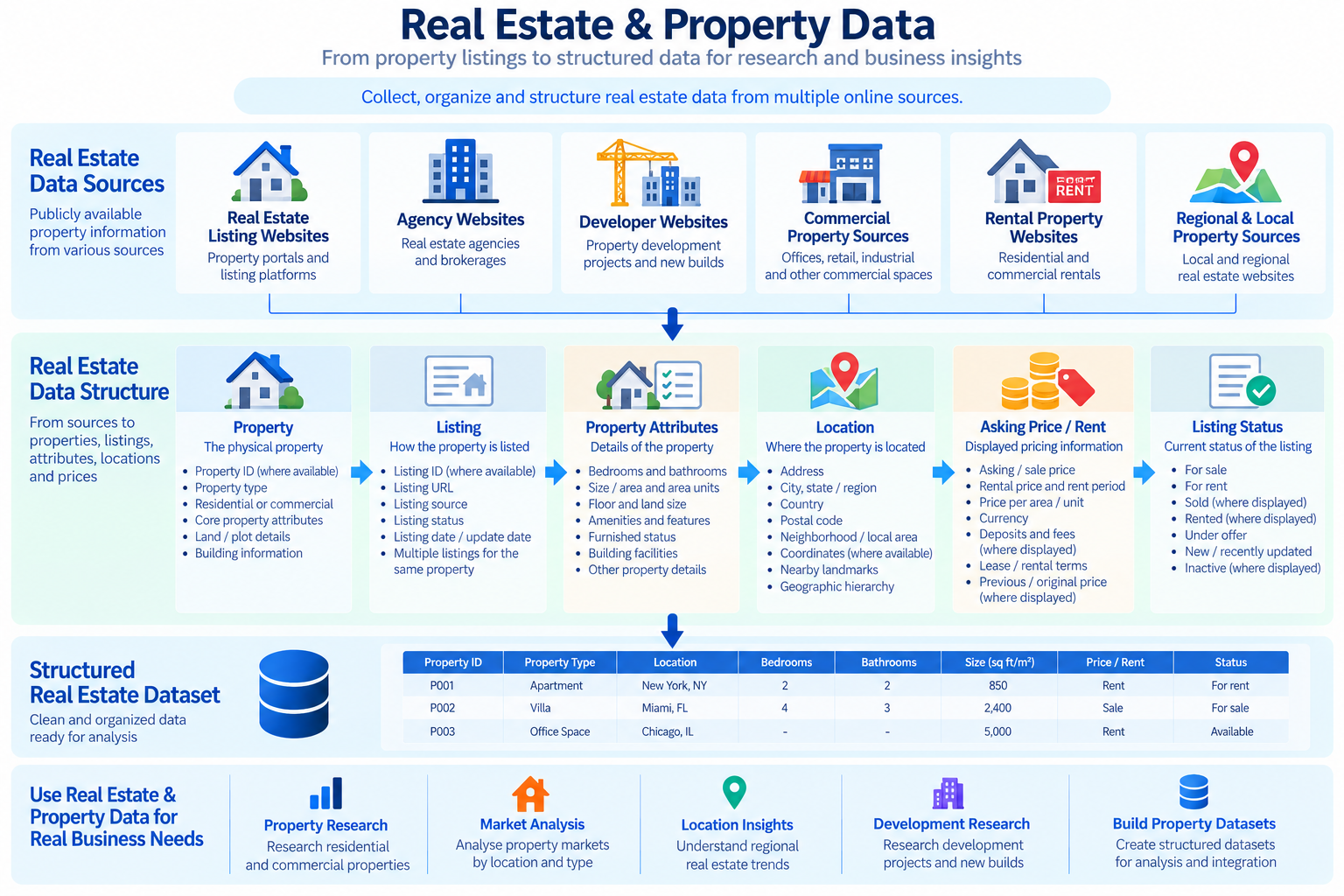
Real estate sources publish properties as listings. A listing typically brings together property attributes, location, an asking price or rent, and a listing status such as for sale, for rent or under offer.
The same property can appear in several listings, across different portals or agencies. Displayed prices are generally asking prices or advertised rents, unless a source publicly provides transaction information.
This page focuses on real estate listing data: the listing-level information that property portals, agency websites and developer sites publish for properties for sale or rent.
Real Estate & Property Data Collection
Real estate and property data is relevant to organizations that need a structured view of properties and property markets, including:
- Real estate agencies and brokerages
- Property developers
- Property investors and analysts
- Property management firms
- Teams building property datasets
- Housing researchers
- Commercial property researchers
Property data has a distinct structure. The property is the underlying asset, while listings are how it is advertised, and each listing carries its own attributes, price or rent, and status. This applies to both residential property, such as houses and apartments, and commercial property, such as offices, retail units and industrial space.
How Real Estate & Property Data Is Organized
Real estate data connects properties, listings, locations, prices and statuses. Understanding how these relate makes it easier to define what a dataset should contain.
Properties, Listings & Agencies
A property and a listing are not the same thing. The same property can be advertised on several portals or by several agencies, and it can be listed more than once over time or for both sale and rent.
Agencies act as listing providers: they publish the listing rather than being the subject of it. Where publicly displayed, listing IDs and property IDs help connect listings to properties, and matching and de-duplication across sources may be needed so that each property is represented once.
Property Types & Attributes
Properties can be residential or commercial, with property types that differ between the two. Where publicly displayed, attributes can include bedrooms, bathrooms, property size, land size, floor information and other property features.
Area units also vary between sources and regions, for example square feet or square meters, so size and price-per-area figures may need to be recorded with their units.
Locations & Geographic Structure
Property locations follow a geographic hierarchy: country, state or region, city, neighborhood or local area, postal code and address. Coordinates and nearby landmarks or locations can be included where publicly displayed.
This structure allows properties to be grouped and compared at different geographic levels.
Asking Prices, Rents & Listing Status
Listings usually show an asking price for sale properties or an advertised rent for rental properties. Where displayed, rent may be stated for a specific period, such as monthly or annually, alongside price per area or unit, currency, deposits, fees and lease or rental terms.
Asking prices are not completed transaction prices. Transaction prices are included only where a source publicly displays them.
Listing status can include values such as:
- For sale
- For rent
- Sold
- Rented
- Under offer
- New or recently updated
Listing dates and update dates can be recorded where publicly displayed.
Types of Real Estate & Property Data
The data types below reflect what real estate sources commonly display. Availability depends on each source and on the scope of the project.
Property & Listing Data
Property and listing data can include property and listing identifiers, property type, residential or commercial classification, listing URL, listing source, listing status, location and other publicly displayed property details.
Property Features & Amenities
Feature data can include bedrooms, bathrooms, size or area, land size and floor. Amenities can include parking, garage, garden, pool, balcony, furnished status, air conditioning, heating, security features, building facilities, accessibility features and other publicly displayed amenities.
Sale Price & Rental Data
Price data can include the asking or sale price, rental price and rental period, price per area or unit, and currency. Where displayed, it can also include a previous or original price, price reductions, deposits, fees and lease or rental terms.
Transaction prices are included only when a source publicly displays them.
Agency & Development Data
Agency data is limited to business-level information, such as agency name, agency URL, agency location and other publicly displayed business attributes.
Development data can include the development or project name, project location, project type and publicly displayed project attributes. Where a project lists individual units, unit-level information can be included where publicly displayed.
Real Estate & Property Data Sources
Real estate data can come from a range of publicly accessible source types, including:
- Real estate listing websites
- Property portals
- Real estate agency websites
- Developer websites
- Development and project websites
- Commercial property sources
- Rental property sources
- Regional or local property websites
- Property directories
- Other publicly accessible real estate sources
Each source type structures properties and listings in its own way, and not every source applies to every project. Collecting listings from several portals and agency sites into one dataset is the work of our real estate website scraping service, with the sources, locations and fields defined for each project.
Real Estate & Property Data Use Cases
Real estate projects usually focus on properties, prices and rents, locations, or a combination of these.
Residential & Commercial Property Research
Researching selected residential or commercial properties, including their types, attributes, locations and listing status.
Asking Price & Rental Research
Recording the asking prices and rents that selected sources publicly display at a given point in time, with the price basis, rent period, area units and currency needed to compare them.
Regional Property Market Research
Studying property markets by geography, including property inventory by area, the mix of property types by location, and regional housing or commercial property research.
Property Database Creation
Building structured datasets of properties, listings, attributes, locations, prices or rents and listing statuses, including development projects where applicable.
Real Estate & Property Data Requirements
Real estate projects are defined by the properties, transaction types and geography involved, and by what each record should represent. The main points to settle are:
- Source websites and platforms
- Property types
- Residential or commercial scope
- Transaction type: sale or rent
- Geography and geographic granularity
- Record grain: property, listing or unit
- Price basis
- Rent period
- Area units
- Currency
- Matching and de-duplication keys, such as address, coordinates, area or bedroom count, where publicly available
- Agency scope, limited to business-level information
- Development or project scope, where applicable
- Required fields
- One-time or recurring collection
Matching keys are not always available on every listing, and they may not be enough on their own to identify the same property across sources.
One-Time and Recurring Real Estate Data
A one-time collection captures selected sources at a single point and can support:
- Residential property research
- Commercial property research
- Property database creation
- Regional property studies
- Asking price and rental research
- Development and project research
Recurring collection records timestamped snapshots of observable listing changes, such as:
- New listings
- Asking price changes
- Rental price changes
- Status changes
- Listings no longer shown
- Property attribute changes where publicly displayed
- Project and unit availability where publicly displayed
How often data is collected depends on the project.
Define Your Real Estate & Property Data Requirement
Real estate data is shaped by the properties, locations and transaction types involved. Before scoping a project, it helps to define:
- Sources
- Residential or commercial scope
- Property types
- Sale or rent scope
- Geography
- Record level: property, listing or unit
- Required fields
- Price or rent basis
- Area units and currency
- Matching requirements
- Development or project scope
- One-time or recurring collection
Private owners, tenants, private sellers and individual contact details are outside the scope of this data. Once these requirements are defined, we can review the project scope and confirm an approach.
Frequently Asked Questions
Can listings be collected for a specific location and property type?
Yes. Scope can be set by geography, such as city, neighborhood or postal code, and by residential or commercial property type, sale or rent, and other filters a source supports. What can be applied depends on how each property website structures its search and listing pages.
Can asking prices and availability be tracked and refreshed over time?
With recurring collection, timestamped snapshots can show new listings, asking price changes, status changes and listings no longer shown. These reflect what each source publicly displays at the time, not completed sale prices. How often snapshots are taken depends on how quickly the sources change and how you use the data.
Can data from several property websites be combined into one dataset?
Yes. Listings from several portals, agency sites and developer sites can be combined through our real estate website scraping work. The same property is often advertised in several places, so matching uses details such as address, coordinates, area or bedroom count where displayed. These are not always available or enough on their own.
How are prices and area units kept comparable across sources?
Sources differ in currency, rent period, such as monthly or annual, and area units, such as square feet or square meters. Each record can keep its price basis, rent period, unit and currency so figures can be compared correctly. Asking prices are recorded as displayed and are not sale prices unless a source shows them.
What property information is not included in a dataset?
Only publicly displayed listing information is considered, such as property type, location, price or rent, size, features and status. Private owners, tenants, private sellers and individual contact details are outside scope. Whether a website can be used also depends on the site itself and any applicable requirements, which are checked at scoping.