

Business directories and local listing sources publish businesses as listings, usually organized by category and location. A single listing can combine a business name, address, category, opening hours and other publicly displayed details in one place.
This page focuses on collecting and structuring that listing-based business and local data, so that listings, businesses, locations and categories can be studied together. Collecting listings from selected directories into a single structured dataset is business directory data extraction: the directories, geography, categories and fields are defined for each project.
Business & Local Directory Data Collection
Directory data is relevant to organizations that need to understand which businesses operate where, and how they are categorized, including:
- Organizations researching local markets
- Businesses planning new locations or expansion
- Agencies working with local businesses
- Analysts studying regional business landscapes
- Teams building business directories or databases
Directory listings are a distinct source because they connect a business to a physical location and to a place in a category structure. That combination is what makes them useful for local and regional research.
How Business & Local Directory Data Is Organized
Directory data has several connected layers. Separating them early makes it easier to decide what a dataset should contain and how records relate to each other.
Listings & Businesses
A listing is not necessarily the same as a business. The same business can appear in several directories, each with its own listing, and the details on those listings do not always match.
A business can also have several locations or branches, each listed separately. Deciding whether a record represents a listing, a business or a location is one of the first choices in a directory project.
Locations & Geography
Location information usually follows a geographic hierarchy: country, state or region, city, local area or neighborhood, and postal code. Some sources also show coordinates, and some service businesses display the service areas they cover.
Where these details are publicly displayed, they allow businesses to be grouped and compared at different geographic levels.
Categories & Directory Placement
Directories place businesses in primary and, often, secondary categories. Each directory uses its own category taxonomy, and category depth and naming can differ considerably between sources.
When data comes from more than one directory, categories may need to be aligned so that similar businesses are grouped consistently.
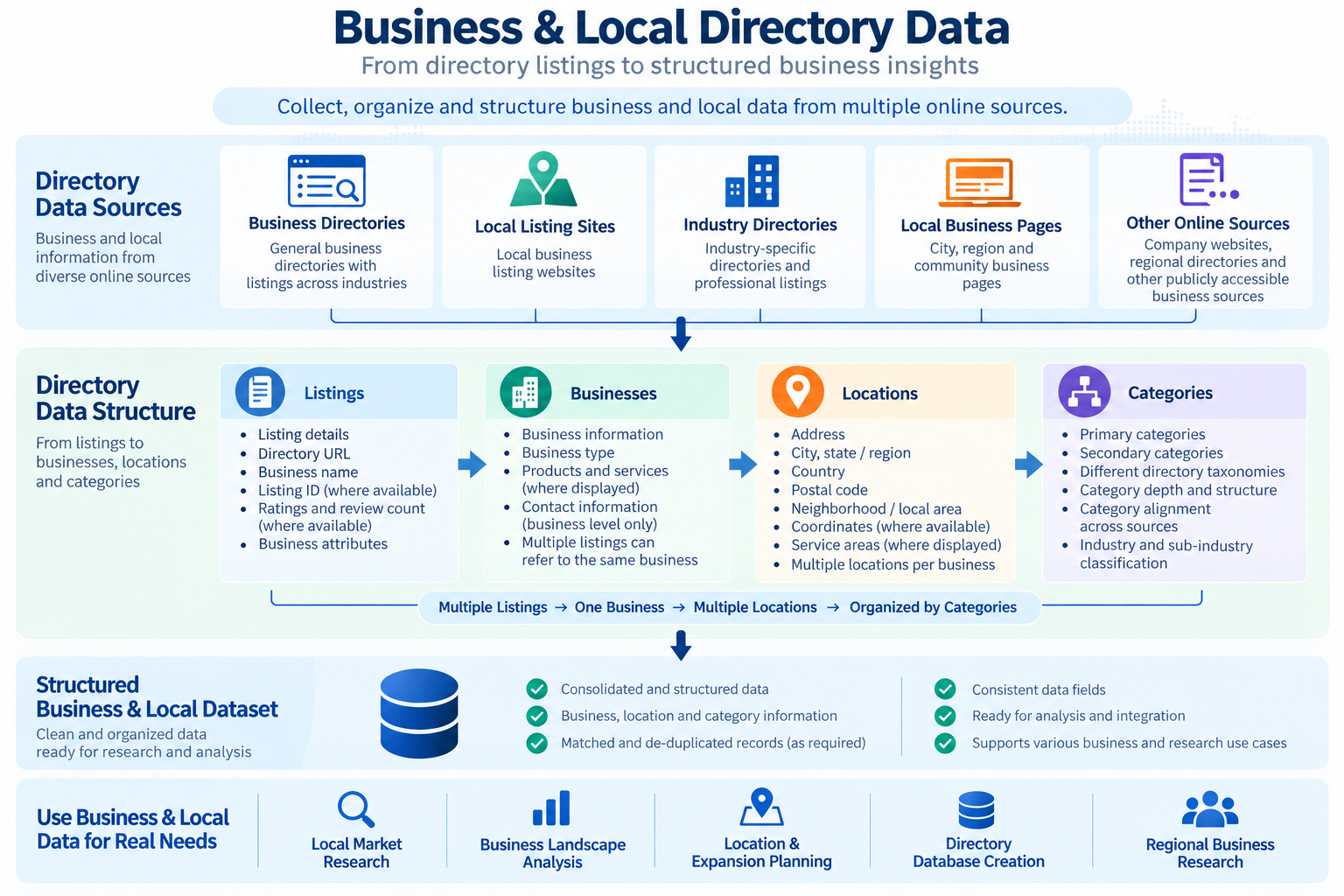
Types of Business & Local Directory Data
The data types below reflect what directory and local listing sources commonly display. Availability depends on each source and on the scope of the project.
Business Listing Data
Listing data describes a business as it appears on a directory. It may include the business name, business URL, directory or listing URL, business ID where displayed, business type and other publicly displayed business attributes.
Where a directory shows them, an aggregate rating and review count can be included as part of the listing.
Location & Address Data
Location data covers the address, city, region or state, country, postal code and neighborhood or local area. Coordinates and service areas can be included where publicly displayed.
Categories, Services & Opening Hours
This covers primary and secondary categories, business specialties, and products or services where publicly displayed. It can also include opening hours and payment or service information where a listing shows them.
Public Business Contact Data
Some listings show business-level contact details, such as the main business phone number, business website, business address and, where appropriate, a contact page URL.
Private, personal or restricted contact information is outside the scope of this data.
Business & Local Directory Data Sources
Business and local data can come from a range of publicly accessible source types, including:
- Business directories
- Local directories
- Industry directories
- Business listing websites
- Local business discovery platforms
- Regional or local business pages
- Company websites
- Other publicly accessible business sources
Each source type organizes listings, locations and categories in its own way, and not every source applies to every project.
Business & Local Directory Data Use Cases
Directory projects usually start from a question about businesses in a particular place, category or set of directories.
Local Market Research
Building a view of the businesses operating in a defined area, organized by category and location, to understand the local market.
Business Landscape by Category & Location
Mapping how businesses in selected categories are spread across cities, regions or local areas, including where particular categories are more or less represented.
Directory Database Creation
Creating a structured database of businesses and locations from selected directories, with categories aligned and duplicate listings resolved where possible.
Business Presence Across Directories
Comparing how selected businesses appear across different directories, such as which directories list them and whether their categories and location details are consistent.
Business & Local Directory Data Requirements
Directory projects are defined by the sources, geography and categories involved, and by what each record should represent. The main points to settle are:
- Directories in scope
- Geographic scope
- Geographic granularity, such as city, local area or postal code
- Category scope
- Record grain: listing, business or location
- Required fields
- Matching and de-duplication keys, such as business name, address, business phone or website
- Business-only contact scope
- One-time or recurring collection
Matching keys are not always available on every listing, and they may not be enough on their own to identify the same business across sources. The matching approach depends on which fields the selected directories display.
One-Time and Recurring Business Directory Data
A one-time collection captures directory listings at a single point and can support:
- Local market studies
- Directory database creation
- Business landscape research
- Regional or category research
Recurring collection can capture observable changes in directory listings, such as:
- New listings
- Listings no longer shown
- Category changes
- Opening-hours changes
- Business attribute changes
- Aggregate rating or review-count changes
- Business contact changes where publicly displayed
Each collection can be recorded as a timestamped snapshot, so changes can be compared over time. How often data is collected depends on the project.
Define Your Business & Local Directory Data Requirement
The right scope depends on the source directories, the geography and categories covered, the record level, the fields needed, and whether the dataset is one-time or recurring. It helps to define:
- Source directories
- Geography
- Categories
- Record level: listing, business or location
- Required fields
- Matching requirements
- Collection frequency
Once these requirements are defined, we can review the project scope and confirm an approach.
Frequently Asked Questions
Can a directory dataset be limited to a specific city, area or category?
Yes. Scope can be set by geography, from country down to city, local area or postal code, and by category, as long as the selected directories display those details. Each directory uses its own category names, so categories from different sources are usually aligned to keep the results consistent.
How are duplicate listings handled when several directories are used?
The same business often appears in more than one directory with slightly different details. Duplicates are resolved where possible using matching keys such as business name, address, phone number or website. These are not shown on every listing, so some records may stay separate or need review.
How often can business listings be refreshed?
Collection can be one-time or recurring, with the schedule set for each project. Recurring runs can show new listings, listings no longer shown and changes to details such as categories or opening hours. How often this makes sense depends on how quickly the selected directories change and how you use the data.
What fields can a business directory dataset include?
Typical fields include business name, address, category, business phone number, website, opening hours and listing URL, plus aggregate rating and review count where shown. The final list depends on what each directory displays and what you need. See our business directory data extraction service for related work.
Which directories can be used for a project?
That depends on your target geography and categories. General, local and industry directories and business listing sites can all be considered. Whether a specific directory can be used depends on how it is structured, what it publicly displays and any applicable requirements, which are checked when the project is scoped.