

Ecommerce and retail businesses rely on product, pricing, availability and market information to run day-to-day operations, track competitors and understand their market. Much of that information is already public on ecommerce websites, marketplaces and retail platforms.
This page covers the kinds of ecommerce and retail data that can be collected, the sources it typically comes from, common use cases, and how a project is scoped.
Ecommerce & Retail Data Collection
Retail and ecommerce websites change constantly: prices shift, products go in and out of stock, and catalogs get updated. Collecting that information manually across multiple sites is slow and hard to keep consistent.
A collection project can be scoped around the specific stores, marketplaces or directories that matter to your business, and the fields your project actually needs.
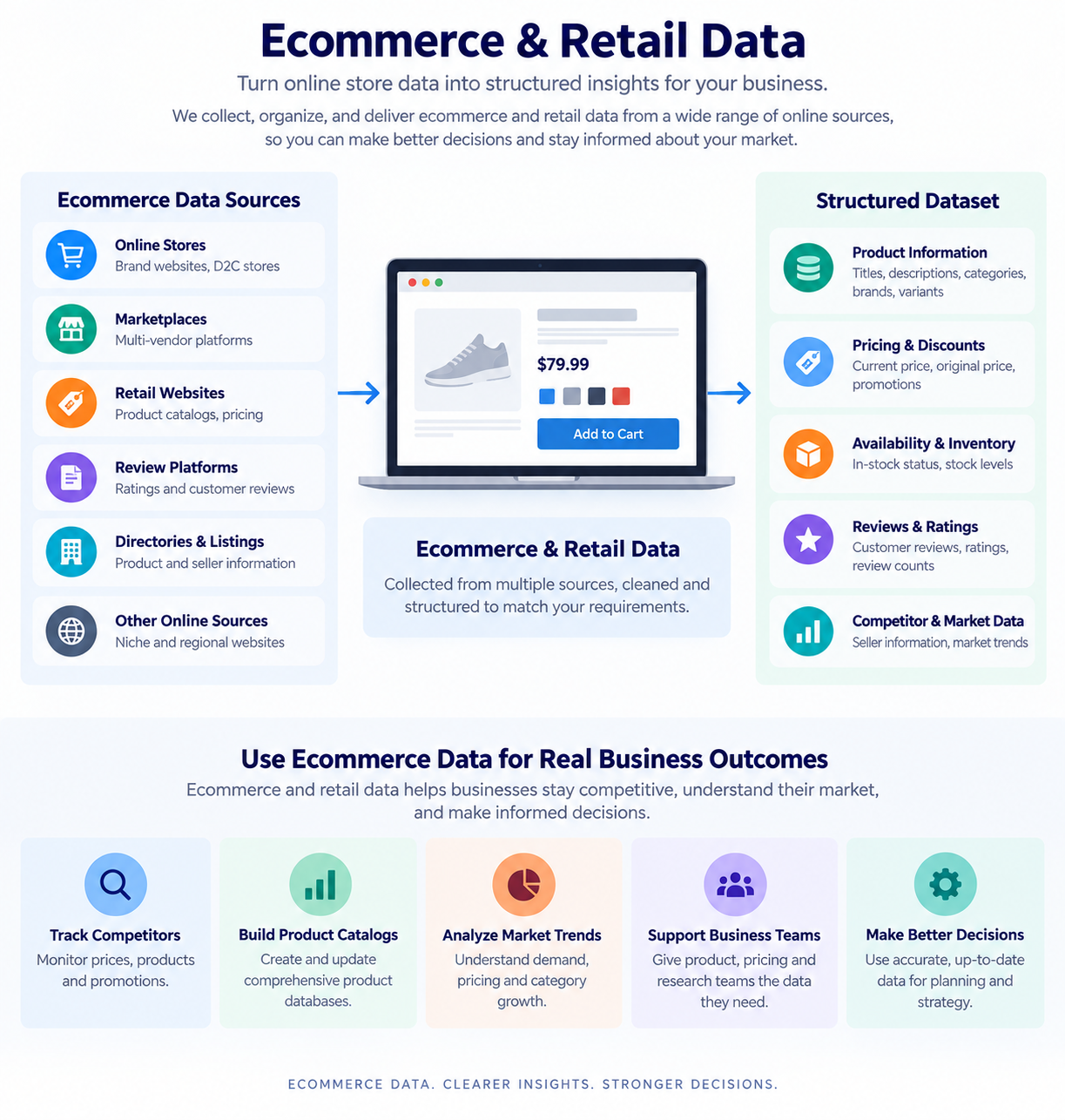
Types of Ecommerce & Retail Data
Depending on the source and the project, ecommerce and retail data can cover several distinct areas:
Product & Catalog Data
Product name, URL, brand, category, description and variant details, as published on product and catalog pages.
Pricing, Discounts & Promotions
Current price, original price, discounts and promotional offers, where a source displays them.
Availability & Inventory
Stock status and availability information, including variant-level or size and color availability where shown.
Reviews & Ratings
Ratings, review counts and review text, where publicly accessible on the product or listing page.
Competitor & Market Data
Product, pricing and category information collected from competitor or market-adjacent sources for comparison.
Ecommerce & Retail Data Sources
Ecommerce and retail data can come from a range of source types, including:
- Online stores and brand websites
- Marketplaces and multi-vendor platforms
- Retail directories and category listings
- Competitor and market-adjacent websites
Which sources apply depends on the project and what each site publishes.
Ecommerce & Retail Data Use Cases
Ecommerce and retail data projects tend to fall into a handful of common patterns:
Competitor Price Research
Collecting product and pricing information from selected competitor websites to support pricing and market analysis.
Product Catalog Creation
Building a structured product catalog from one or more online stores or retail websites.
Marketplace Data Collection
Collecting product, seller, pricing and category information from selected online marketplaces.
Product Tracking
Collecting selected product information again over time to keep a dataset current.
Retail Market Research
Gathering product, brand, category and pricing information from multiple sources for broader market research.
Ecommerce Data Requirements
What matters for an ecommerce or retail project usually comes down to a few things:
- The stores, marketplaces or directories in scope
- The fields required for each record
- Whether the data is needed once or on a schedule
- The output format required
One-Time and Recurring Ecommerce Data
A one-time collection fits a defined need such as a market study, competitor snapshot or catalog build. Recurring collection fits situations where prices, availability or listings need to be checked again over time, since ecommerce information tends to change frequently.
Which approach fits depends on how the data will be used, not on the industry itself.
From Ecommerce Sources to Structured Dataset
A defined set of sources is collected, the required fields are extracted, and the result is organized into one structured dataset, with consistent fields across every product, listing or record.
Define Your Ecommerce Data Requirement
Before scoping the work, it helps to define:
- The stores, marketplaces or sources you need data from
- The fields required for each record
- Whether the need is one-time or recurring
- Your preferred output format
Once these are defined, we can review the requirement and confirm an approach.