

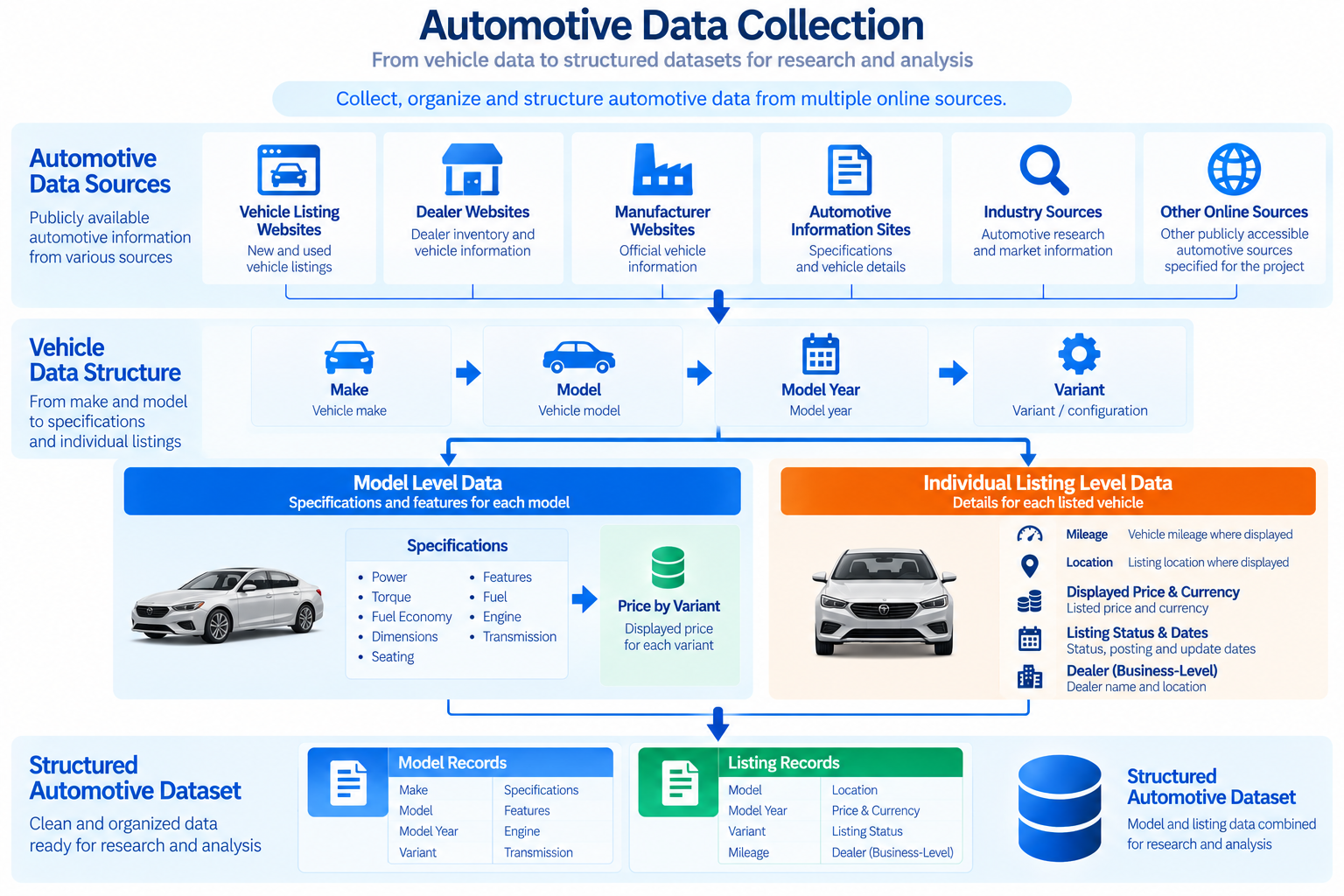
Automotive information is published at two levels. Some sources describe a vehicle as a model, with its make, model year, variants and specifications and, where publicly displayed, model-level pricing. Others describe an individual vehicle offered for sale, as a listing with its own mileage, location, displayed price and status where publicly displayed.
The same vehicle or model can appear across several sources, and each source presents it with its own fields, naming and formats. Structured collection helps organize these differences, so that model information, listings and dealers are recorded consistently and can be compared.
Automotive Data Collection
Automotive data is relevant to research and analysis teams, product and market researchers, and dealers who work with vehicle, model and inventory information.
Automotive data has a structure of its own. Vehicle identity is built from the make, the model, the model year and the variant. Specifications describe what a model is. An individual listing describes one vehicle that a seller is offering, with details such as mileage, location, displayed price and status where publicly displayed. Keeping model information and listing information distinct is what makes an automotive dataset usable.
How Automotive Data Is Organized
Automotive data is easier to work with when it is clear which level a record belongs to. Model and catalog information describes a type of vehicle, individual listings describe vehicles offered by sellers, and dealers appear as the business behind a listing. Deciding what each record in a dataset represents is one of the first choices in an automotive data project.
Vehicles, Listings & Dealers
A model or catalog page describes a vehicle as a type: its make, model, model year, variants and specifications and, where publicly displayed, pricing by variant. A vehicle listing is different. It is the individual vehicle that a seller is offering, with its own mileage, location, displayed price and status where publicly displayed.
A dealer appears as the business-level seller behind a listing, with the dealer’s name, location and the brands it represents where displayed. The listing remains the primary record for an individual vehicle, and the dealer is an attribute of it. Dealer information stays at business level.
The same vehicle can appear on more than one source, such as a dealer website and a vehicle marketplace, and the same model can be described by several sources. When a project draws on more than one source, matching and de-duplication decide whether two records describe the same vehicle or the same model. The fields available for matching depend on what each source displays.
Makes, Models, Years & Variants
Vehicle identity is built up in layers. The make is the brand, the model is the vehicle line within that make, the model year identifies the year of the model, and the variant identifies the version of that model. Where a source displays them, each layer is a separate field, so vehicles can be grouped and compared at the make, model, year or variant level.
Sources name and group variants in their own way, so variant names and groupings may need to be aligned when data comes from more than one source. Pricing can also differ by variant, which is why price by variant is recorded at the model level where publicly displayed.
Specifications, Mileage & Vehicle Attributes
Specifications describe what a model is. Where publicly displayed, they can include power, torque, fuel economy, dimensions and seating capacity, together with safety, technology, exterior and interior features. Fuel, engine and transmission describe how the vehicle is configured.
Mileage belongs to the individual vehicle, not to the model. Where a listing displays it, mileage is recorded on the listing record, while specifications stay with the model or variant. Values can be recorded with the units the source uses.
Location, Displayed Price & Listing Status
Where displayed, location is recorded for the dealer or for the listing.
A listing shows a current or displayed price, and some sources also show an original price, a sale price or discount information. Model-level pages can show price by variant. Prices are recorded with their currency, and financing information is included where publicly displayed. Displayed prices are what a source shows, not completed transaction prices, unless a source publicly displays that information.
Each listing also has a status and dates. Status can show whether a vehicle is available and, where the source states it, whether it is new or used. Listing dates and update dates can be recorded where publicly displayed.
Types of Automotive Data
The data types below reflect what automotive sources commonly display. Which of them apply depends on the project and on what each selected source publicly shows.
Vehicle & Model Data
Model-level data describes a vehicle as a type. It may include:
- The make
- The model
- The model year
- The variant
- The vehicle type
- The aggregate rating and review count, where displayed
Ratings are limited to aggregate figures where a source displays them.
Vehicle Specification Data
Specification data describes a model or variant. Where publicly displayed, it may include:
- Power
- Torque
- Fuel economy
- Dimensions
- Seating capacity
- Safety features
- Technology features
- Exterior features
- Interior features
- The engine
- The transmission
- The fuel type
Listing, Price & Availability Data
Listing data describes an individual vehicle as a source displays it. Where publicly displayed, it may include:
- The individual listing
- The mileage
- The displayed price
- The original price, sale price or discount information
- The currency
- The availability or status of the vehicle
- The listing date or update date
Listing values reflect what the source displayed at the time of collection.
Dealer Data (Business-Level)
Dealer data is limited to business-level information about the seller. Where publicly displayed, it may include:
- The dealer or business name
- The website URL
- The business location
- The brands represented
- The business phone number
It does not include private sellers, private owner information or individual personal contact details.
Automotive Data Sources
Automotive data can come from a range of publicly accessible source types, including:
- Dealer websites
- Manufacturer websites
- Vehicle marketplaces
- Automotive websites
- Other public online sources specified for the project
Not every source type applies to every project, and the same kind of source can present vehicles, models and listings differently from one website to another.
Automotive Data Use Cases
Automotive data projects usually start from a question about vehicles, models or listings. Some focus on model and specification information, others on individual listings, and some combine the two.
Vehicle Market Research
Building a structured view of the vehicles and models available across selected sources: which models are present, how vehicles are spread across makes, model years and variants, and what pricing the sources display. Model presence across sources can be compared when records are matched.
Model & Variant Research
Comparing selected models and variants by their specifications, features and model-level pricing where publicly displayed, and looking at how variants of the same model differ. Results describe the information the selected sources display.
Listing & Displayed Price Research
Working with individual vehicle listings: displayed prices, mileage where displayed, listing status, and the split between new and used listings where the selected sources show it. Prices are recorded as displayed at the time of collection.
Vehicle Dataset & Catalog Creation
Building structured datasets from selected sources: vehicle and model databases, specification datasets and listing datasets, with model records and listing records kept distinct.
Automotive Data Requirements
Automotive projects are defined around the sources, the vehicles in scope and the level each record should represent. The main points to settle are:
- Source websites
- Makes and models in scope
- Model years
- Variants
- New or used scope, where the selected sources show it
- Geographic scope, based on the locations the sources display
- Record level: model or listing
- Required fields
- Price basis and currency
- Listing status handling
- Collection dates
- Matching and de-duplication requirements
- Dealer scope, limited to business-level information
- One-time or recurring collection
Private sellers, private owner information and individual personal contact details are outside the scope of this data.
One-Time and Recurring Automotive Data
A one-time collection captures selected sources at a single point and can support:
- Vehicle and model research
- Specification datasets
- Listing and displayed price research
- Vehicle database creation
Recurring collection records timestamped snapshots of listings, prices and publicly displayed status over time, so that observable changes can be compared. These can include:
- New listings
- Displayed price changes
- Listing status changes
- Listings no longer shown
- Changes to price by variant, where publicly displayed
How often data is collected depends on the project requirement. Each snapshot reflects what a source displayed when it was collected, and coverage depends on the selected sources.
Define Your Automotive Data Requirement
A clear requirement makes it easier to choose the right sources and record structure. A project can be scoped around the sources, the vehicle and model scope, the listing scope, the required fields, the geography and the collection schedule. Once these are defined, we can review the project scope and confirm an approach.