

B2B research often draws on information spread across company websites, business directories, industry websites, B2B platforms, marketplaces and other selected online sources. Each source presents businesses, products and services in its own way.
This page focuses on structured B2B information about businesses, their products and services, the industries and markets they operate in, and the suppliers and vendors behind them. What is available depends on what each selected source publicly displays.
B2B market research data is built around the company: its profile, firmographic attributes, offerings and supplier relationships. A project defined instead by a market scope, with prices, ratings and announcements tracked across an industry or category as timestamped snapshots, falls under Market Intelligence Data.
B2B & Market Research Data Collection
B2B research data is relevant to organizations and teams that need a structured view of businesses and markets, including:
- B2B companies researching their own markets
- Sales and business development research into selected companies
- Market research covering industries, categories and segments
- Procurement and supplier research
- Marketing and segmentation research
- Analysts researching companies, industries, products and services
Unlike consumer retail data, B2B research usually centers on the business itself: who the company is, what it offers, which industry and market it belongs to, and how it relates to suppliers and other businesses.
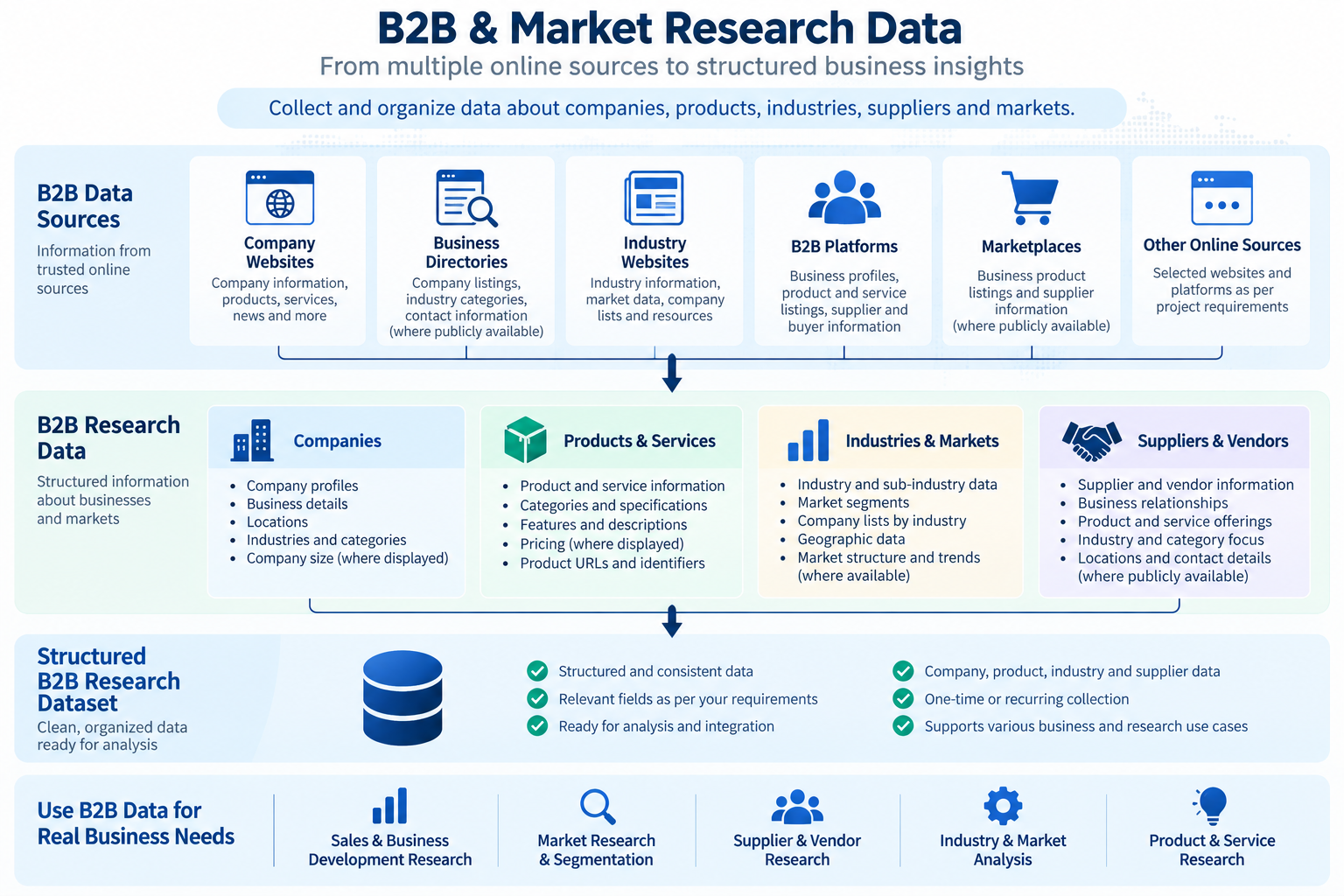
How B2B Research Data Is Organized
B2B research data usually falls into a few connected layers. Deciding which layers a project needs shapes how records are defined and linked.
Company & Organization Data
The company layer describes the business itself. Where available, this can include the company name, website, industry, business category, location, description and other publicly displayed business attributes. Firmographic attributes such as company size, founding year and industry classification are included where a source displays them, which is what allows companies to be grouped and compared by segment.
In most B2B datasets, the company record is the anchor that other information links back to.
Products & Services
Many B2B sources list the products and services each business offers. Where displayed, this can include product or service names, URLs, descriptions, categories, specifications or features, and publicly displayed pricing.
These records are usually linked to the company that offers them.
Industry & Market Structure
Selected sources often group businesses by industry, sub-industry, business category or market segment. Where displayed, this structure can connect companies, products, services and locations.
Classification schemes vary between sources, so categories from different sources may need to be aligned.
Suppliers & Business Relationships
Supplier and vendor research looks at which businesses provide particular products or services. Directories, B2B platforms and supplier listings can show relationships between businesses, their offerings and the categories they serve, where publicly available.
Types of B2B & Market Research Data
The data types below reflect common B2B research needs. Which of them apply depends on the project and on what the selected sources publicly display.
Company Profile Data
Company profile data may include the business name, website, industry, category, location, address and description. Where publicly displayed, it can also include firmographic attributes such as company size or founding year.
Product & Service Data
Product and service data records what selected businesses offer, including names, descriptions, categories, specifications or features, and pricing where publicly displayed. Each record can be linked to the business offering it.
Industry & Market Data
Industry and market data covers how businesses are classified and grouped: industries, sub-industries, business categories, market segments and locations, as shown by the selected sources.
Public Business Contact Data
Some projects include business contact information that companies publicly display on their own websites or in selected directories. This can include a main business phone number, a general business email address, a contact page URL and a business address.
The scope is limited to publicly displayed company contact information. It does not extend to private, restricted or personal contact information.
B2B & Market Research Data Sources
B2B research data can come from a range of source types. Relevant sources, where publicly available, may include:
- Company websites
- Business directories
- Industry websites
- B2B platforms
- Marketplaces
- Supplier and vendor sources where publicly available
- Other selected online sources specified for the project
Not every source type applies to every project, and the same kind of source can be structured differently from one website to another.
B2B & Market Research Use Cases
B2B research projects are usually built around a few common questions.
Account & Company Research
Building structured company information for research into selected businesses, such as their industry, location, offerings and publicly displayed business details.
Supplier & Vendor Research
Collecting supplier, vendor and business offering information from selected B2B sources to understand who provides particular products or services.
B2B Market & Industry Research
Mapping companies, industries, categories, products, services, locations and market segments within a defined market.
Product & Service Research
Researching or comparing selected B2B products and services across businesses. This can include research into competing providers as part of wider B2B research.
B2B Data Requirements
B2B projects are defined around the businesses, industries and markets being studied. The main points to settle are:
- Businesses or companies in scope
- Industries and categories
- Geographic scope
- Websites, directories and platforms
- Company-level or product and service-level records
- Required fields
- Matching identifiers, where applicable
- Public business contact scope
- One-time or recurring collection
The right record structure depends on whether the project is centered on companies, products and services, suppliers, industries, or a combination of these.
One-Time and Recurring B2B Data
A one-time dataset captures selected B2B information at a single point and can support:
- Company research
- Supplier research
- Industry database creation
- B2B market research
- Product and service research
Recurring collection can be appropriate when selected information needs to be refreshed periodically, such as:
- Company information
- Product and service information
- Supplier information
- Industry and category information
- Selected B2B research datasets
The collection schedule depends on how often the selected information changes and how the dataset will be used.
Define Your B2B Data Requirement
A clear requirement makes it easier to identify the right sources and record structure for a B2B project. It helps to outline:
- Companies, industries or markets
- Websites or source types
- Locations
- Required fields
- Record level
- One-time or recurring collection
Once these requirements are defined, we can review the project scope and confirm an approach.
Frequently Asked Questions
How are company records matched when data comes from several B2B sources?
Each source describes a business differently, so records are usually matched on shared details such as company name, website, location or an identifier where one is displayed. Those details are not shown on every listing, so matching is not always exact. The approach is agreed once the selected sources are known.
Can a B2B dataset be built around our own research criteria?
Yes. A project is scoped around your target industries, categories, locations, source websites and required fields, at company level or at product and service level. Only information that the chosen sources publicly display can be collected, so availability is confirmed with you before the work starts.
How often can a B2B dataset be refreshed?
The schedule is set for each project, from a one-time collection to recurring data feeds. Company details often change slowly, while product, pricing or supplier listings can change faster, so the schedule usually follows how quickly the selected sources are updated and how you plan to use the data.
Are there limits on which websites can be used?
Yes. Whether a website can be used depends on the site itself, what it publicly displays and any applicable requirements, which are reviewed when the project is scoped. Private, restricted or personal contact information is outside scope, and only publicly displayed business information is considered.
In what formats can B2B research data be delivered?
Datasets are commonly delivered as CSV, Excel or JSON files, and API delivery can be used where a project calls for it. Fields, record level and column structure are agreed up front, so the output fits your spreadsheet, database or analysis workflow.