

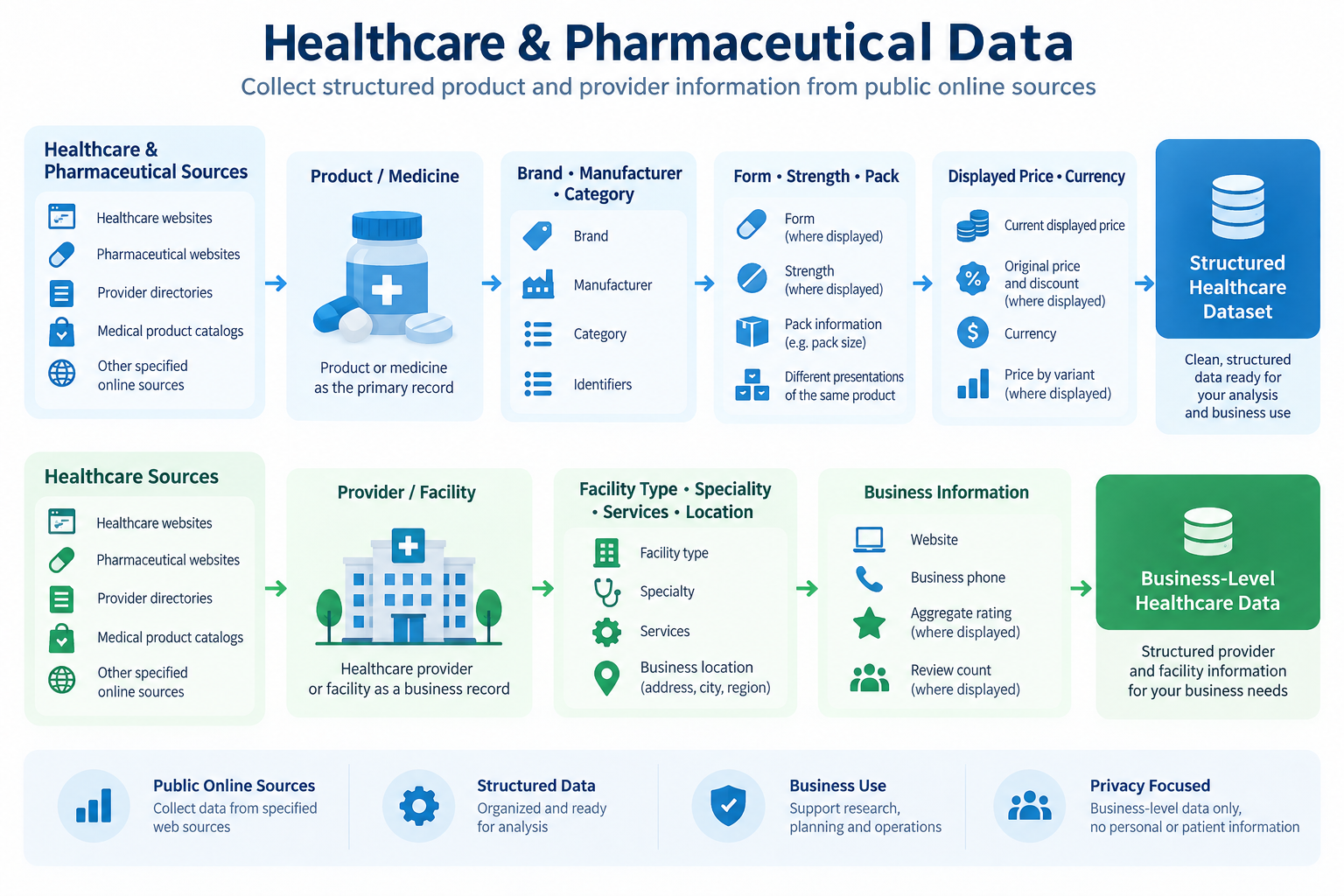
Healthcare and pharmaceutical sources publish product and medicine information organized around the brand, the manufacturer, the form, the strength and the pack, together with displayed pricing. Where a source publicly displays them, these details define what a product is and how it is offered.
The same medicine can appear on several sources in different forms, strengths and packs, and with different displayed prices. Provider and facility information can also be collected, but only at business level. Structured collection helps keep these differences organized, so that products, packs and prices can be compared.
Healthcare & Pharmaceutical Data Collection
Healthcare and pharmaceutical data is relevant to organizations that need a structured view of products and prices, including:
- Healthcare and pharmaceutical researchers working with product information
- Market researchers studying products and prices
- Teams building structured product datasets
- Teams researching business-level provider and facility information
Healthcare and pharmaceutical product information has attributes that a standard retail product record does not. A medicine is identified by more than its name: the brand, the manufacturer, the form or presentation, the strength and the pack all describe which product is being offered, and the same medicine can be listed in several combinations of these. Keeping those attributes distinct is what makes a healthcare product dataset usable. Where a source displays them, price and currency attach to the product and pack.
How Healthcare & Pharmaceutical Data Is Organized
Healthcare and pharmaceutical data is easier to work with when it is clear what each record represents. The product or medicine is the primary record, and its manufacturer, form, strength, pack and price attach to it. Provider and facility information is a separate, secondary record type that stays at business level.
Products, Medicines & Manufacturers
A product or medicine is the primary record. It is identified by its name and brand, its manufacturer and its category, together with any identifiers a source displays.
The same product can appear on more than one source under slightly different names or with different identifiers. When a project draws on more than one source, matching decides, where possible, whether two records describe the same product. The fields available for matching depend on what each source displays.
Forms, Strengths & Packs
Form or presentation, strength and pack information describe how a product is offered. Where a source displays them, each is a separate field on the product record. The same medicine can be listed in several forms, strengths and packs, and each combination can carry its own displayed price, including a pack price.
Keeping these as separate fields prevents different presentations of the same medicine from being treated as one product or as unrelated products. This is what separates healthcare and pharmaceutical product data from a standard product catalog: the presentation is part of the product’s identity, not an optional detail.
Prices & Currency
Where a source displays them, price data can include the current displayed price, an original displayed price, discount information and a pack price, together with the currency. Where price differs by variant, the variant price is recorded against the product.
A displayed price is a point-in-time observation. It is what the source showed when the data was collected.
Providers & Facilities (Business-Level)
Provider and facility information is collected at business level only, as a secondary record type. Where publicly displayed, it can include the name of the provider or facility, its facility type, its specialty and services, its business location, website and business phone number, and an aggregate rating and review count.
Provider entries describe the business or facility as it is listed. They do not describe the individuals who work there or the people who use it.
Types of Healthcare & Pharmaceutical Data
The data types below reflect what healthcare and pharmaceutical sources commonly display. Which of them apply depends on the project and on what each selected source publicly shows.
Pharmaceutical Product Data
Pharmaceutical product data describes a medicine or pharmaceutical product as a source displays it. Where publicly displayed, it may include:
- The product name
- The brand
- The manufacturer
- The product category
- The form or presentation
- The strength
- The pack information
- The product description
- Publicly displayed identifiers
Healthcare Product Data
Healthcare product data describes healthcare and medical products as a source displays them. Where publicly displayed, it may include:
- The product name and URL
- The brand and manufacturer
- The product category
- The product description and specifications
- Product identifiers
- Images or image URLs
Pricing Data
Pricing data describes what a source displays for a product or pack. Where publicly displayed, it may include:
- The current displayed price
- The original displayed price
- Discount information
- The pack price
- The currency
- Price by variant
Prices reflect what the source displayed at the time of collection.
Provider & Facility Data (Business-Level)
Provider and facility data is limited to business-level information. Where publicly displayed, it may include:
- The provider or facility name
- The facility type
- The specialty
- The services
- The business address or location
- The website
- The business phone number
- The aggregate rating and review count
Ratings are limited to the aggregate rating and the review count.
Healthcare & Pharmaceutical Data Sources
Healthcare and pharmaceutical data can come from a range of publicly accessible source types, including:
- Healthcare websites
- Pharmaceutical websites
- Provider directories
- Medical product catalogs
- Other online sources specified for the project
Collected information remains subject to each source’s access conditions and permitted use requirements. Not every source type applies to every project, and each source presents products and listings in its own way.
Healthcare & Pharmaceutical Data Use Cases
Healthcare and pharmaceutical data projects usually start from a question about products, prices or providers. What the data describes is limited to what the selected sources publicly display.
Pharmaceutical & Medicine Product Research
Building structured datasets of selected medicines and pharmaceutical products, with their brand, manufacturer, category, form, strength and pack, so that different presentations of the same medicine can be compared across sources.
Healthcare Product Research
Building structured datasets of selected healthcare and medical products, with their brands, manufacturers, categories, descriptions, specifications and identifiers, for product and market research.
Healthcare Price Research
Comparing publicly displayed prices for selected products and packs, with the currency, pack price and price by variant needed to compare them. Prices are recorded as displayed at the time of collection.
Provider & Facility Research
Researching healthcare providers and facilities at business level: facility type, specialty, services and location as listed by the selected sources. This research does not extend to individuals.
Healthcare & Pharmaceutical Data Requirements
Healthcare and pharmaceutical projects are defined around the sources, the products in scope and the record that each row should represent. The main points to settle are:
- Source websites
- Products or medicines in scope
- Manufacturers
- Categories
- Forms
- Strengths
- Packs
- Price basis, such as single-item price or pack price
- Currency
- Provider and facility scope, limited to business level
- Record level: product or medicine, or provider and facility
- Required fields
- One-time or recurring collection
The scope is limited to publicly displayed product, pricing and business-level provider and facility information. Patient data, medical records, prescriptions, diagnoses, individual health information, private clinical records, individual practitioners’ personal contact information and review text are outside the scope.
One-Time and Recurring Healthcare & Pharmaceutical Data
A one-time collection captures selected sources at a single point and can support:
- Pharmaceutical and medicine product research
- Healthcare product research
- Healthcare price research
- Provider and facility research
- Product dataset creation
Recurring collection repeats the same sources and fields as timestamped snapshots of publicly displayed information, so that changes in the requested source data can be captured and compared over time. How often data is collected depends on the project requirements. Each snapshot reflects what a source displayed when it was collected, and coverage depends on the selected sources.
Define Your Healthcare & Pharmaceutical Data Requirement
A clear requirement makes it easier to choose the right sources and record structure. A project can be defined by the sources, the products, the fields, the record level and the collection requirement. Once these are defined, we can review the project scope and confirm an approach.