

Marketplaces and multi-vendor platforms organize information differently from a single retailer’s own website. On a retailer’s site, one company typically lists and sells each product. On a marketplace, the same product listing can carry offers from several independent sellers, each with its own price, condition, fulfillment details and seller profile.
Depending on the marketplace, publicly displayed data can include product listings, multiple seller offers, seller and storefront information, search and category placement, and marketplace-specific identifiers and structures. What is available varies by platform and by page, so each project is scoped around what the selected sources actually display.
Marketplace & Online Retail Data Collection
Marketplace data is relevant to businesses and teams whose work depends on how products and sellers appear on multi-vendor platforms, including:
- Third-party sellers reviewing the marketplaces and categories they sell in
- Brands selling through marketplaces, directly or through resellers
- Marketplace-focused agencies working on behalf of sellers or brands
- Aggregators and analysts studying marketplace products, sellers or categories
- Teams researching a marketplace or category before entering it
The main difference from a single retailer’s site is structure. A product listing, the individual seller offers attached to it, and the sellers behind those offers can each be treated as a separate data layer. Online retail platforms that host third-party sellers alongside their own stock follow a similar pattern.
How Marketplace Data Is Structured
Most marketplace projects work with some combination of three layers. Knowing which layers matter shapes what gets collected and how the dataset is organized.
Listings & Products
The listing layer describes the product itself: title, brand, category, main attributes and the listing URL. Many marketplaces also assign their own product identifiers, and some display manufacturer codes such as UPC or EAN.
Where publicly displayed, these identifiers are useful for linking a listing to its offers and for matching the same product across marketplaces.
Offers & Sellers
A single listing can have one offer or many. Each offer belongs to a specific seller and can differ from other offers on the same product. Where publicly displayed, offer-level information can include:
- Seller or storefront name
- Seller-specific price
- Offer condition, such as new or used
- Fulfillment and shipping information
- Seller rating and review or feedback count
- Number of offers on the listing
Keeping offers separate from the product avoids mixing one seller’s details with another’s.
Search, Category & Placement
Marketplaces also show where a product appears: its position in keyword search results, its position within a category, and its place in the category hierarchy. Some platforms display bestseller or similar labels and mark sponsored placements.
Because these positions change, placement data is usually captured as a ranking snapshot tied to a specific keyword, category and date.
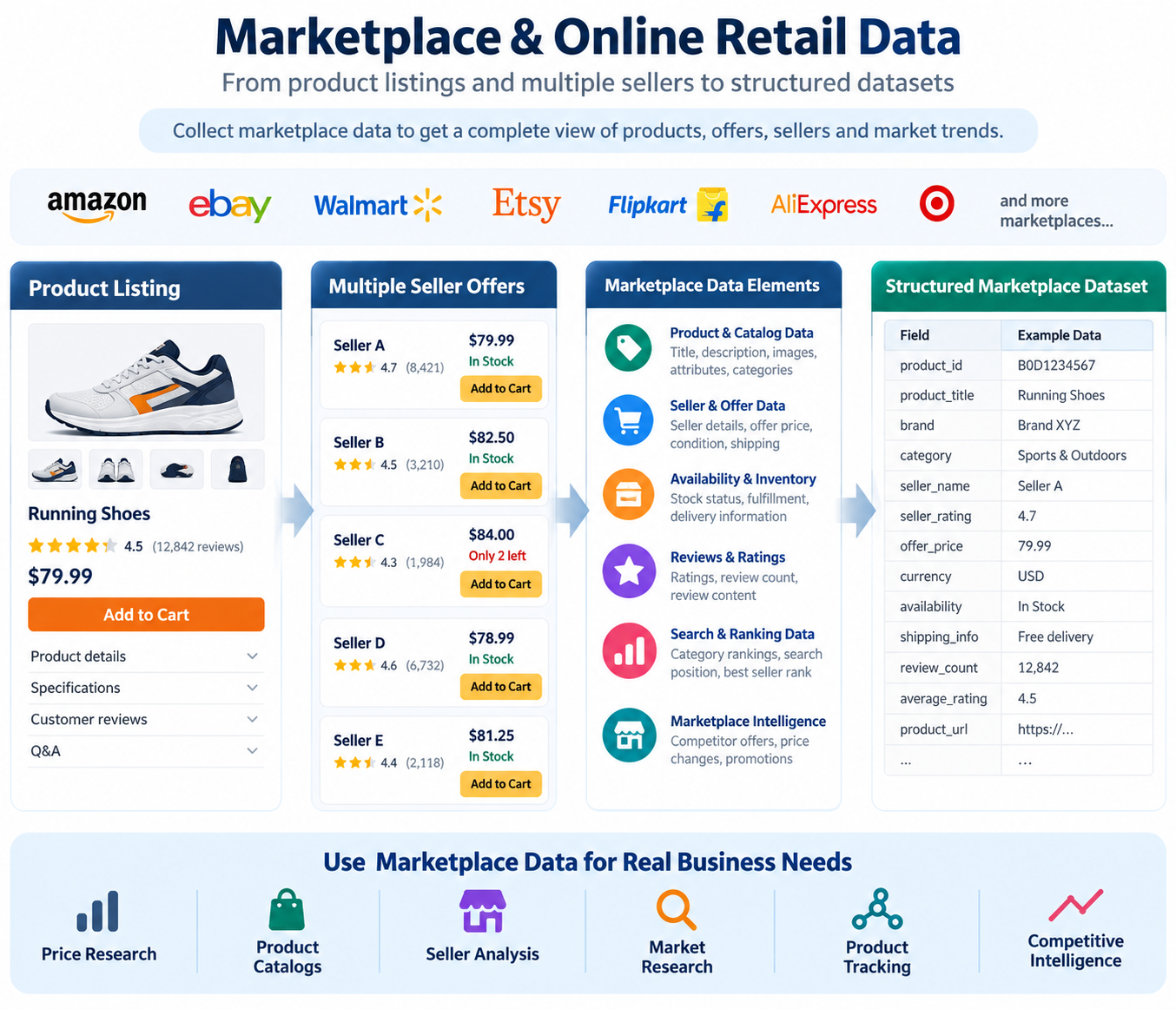
Types of Marketplace Data
The data types below focus on what is specific to marketplaces. Which of them apply depends on the platform and on what it publicly displays.
Seller & Storefront Data
Seller-level data describes the businesses selling on a marketplace. Where publicly displayed, this can include the seller or storefront name, storefront URL, seller rating, feedback or review count, fulfillment information and seller badges.
Collected at the seller level, it shows who is active in a category, independent of any single product.
Offer & Pricing Data by Seller
Offer-level data records what each seller offers on a given listing: the seller, the displayed price, condition and availability where displayed, and fulfillment or shipping information.
Because offers can change, each record is usually tied to the date and time it was collected, so it reflects the offer as it appeared at that point.
Search Rank & Category Placement
Placement data records where listings appear for defined keywords and categories: search position, category placement, bestseller or ranking labels, and sponsored or organic indicators where displayed.
Each record can be tied to a timestamped snapshot, since placement for the same search can differ from one day to the next.
Marketplace Ratings & Seller Feedback
Ratings on marketplaces cover both products and sellers. Where publicly displayed, this can include a product’s average rating and review count, a seller’s rating and feedback count, and other aggregate feedback summaries.
Collection focuses on aggregate figures rather than individual reviewers.
Marketplace Data Sources
Marketplace data can come from several page types within a platform. Relevant source types, where publicly displayed on the selected sources, can include:
- Product and listing pages
- Offer listings showing multiple sellers for one product
- Seller storefronts and seller profile pages
- Keyword search result pages
- Category pages
- Bestseller and ranking pages
- Seller feedback pages
- Regional marketplace domains for different countries or markets
Not every marketplace offers every source type, and the same page type can be structured differently from one platform to another.
Marketplace Data Use Cases
Marketplace projects are usually built around one of a few recurring questions.
Seller Landscape Research
Understanding which sellers are active in a category or on a set of products, how many offers they carry, and how their storefronts and ratings appear. The dataset is typically organized at the seller level.
Cross-Marketplace Product Comparison
Comparing the same or matched products across different marketplaces. Marketplace identifiers, manufacturer codes and consistent attributes help link listings that refer to the same product, since titles often differ between platforms.
Search & Category Visibility Tracking
Recording the positions of selected listings for defined keywords and categories. When recurring collection is required, timestamped snapshots show how placement shifts over time.
Marketplace Assortment Research
Mapping what a marketplace carries within selected categories: which products are listed, how many sellers offer them, and how coverage compares across marketplaces or regional domains.
Marketplace Data Requirements
Marketplace projects are defined by the structure and scope of the marketplace being studied, not only by a list of fields. The main points to settle are:
- Source or marketplace scope
- Keyword, category, product-ID or seller-list scope
- Search depth or category depth
- Record grain: product, offer or seller level
- Marketplace identifiers and matching keys
- Regional marketplace or domain scope
- Required output fields
The right record structure depends on what the project centers on. A product-level dataset has one row per listing, an offer-level dataset has one row per seller offer, and a seller-level dataset has one row per seller.
Projects that combine products, offers, sellers, search placement and categories usually need linking fields between those layers.
One-Time and Recurring Marketplace Data
A one-time collection captures the marketplace at a single point and can support:
- Marketplace research
- Category studies
- Seller landscape analysis
- Assortment research
- Cross-marketplace comparison
Recurring collection can be appropriate when tracking marketplace information that changes over time, such as:
- Seller offers
- Displayed prices
- Availability, where publicly displayed
- Search positions
- Category placement
- Seller information
Recurring snapshots can be timestamped so that changes can be compared from one collection to the next.
Define Your Marketplace Data Requirement
Before scoping a marketplace project, it helps to define:
- Marketplace or source
- Product, offer, seller, search or category scope
- Required fields
- Search or category depth
- Record grain
- Geographic or regional scope
- One-time or recurring collection
- Output format
Once these requirements are defined, we can review the project scope and confirm an approach.