

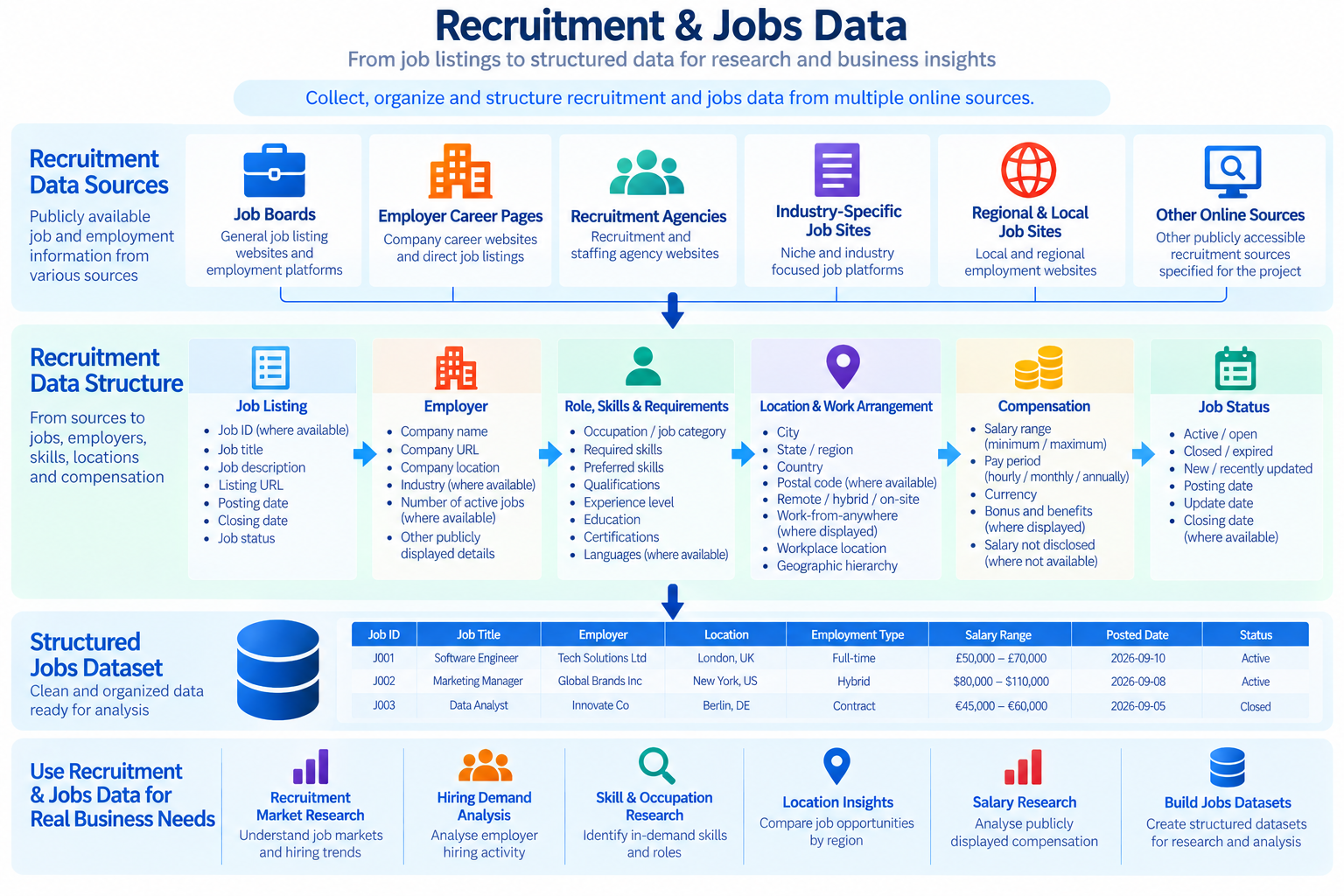
Publicly accessible job sources publish each vacancy as a listing. A single listing can describe the role, the employer, the skills and qualifications expected, the location, the employment conditions, the salary where one is displayed, and the status and dates of the listing itself.
The same role or employer often appears on more than one source, and each source structures its listings differently. Job datasets built from several sources may therefore need matching and de-duplication, so that one vacancy is not counted several times.
Recruitment & Jobs Data Collection
Recruitment and jobs data is relevant to organizations that need a structured view of advertised jobs, including:
- Recruitment firms researching the roles and employers active in their markets
- HR and workforce analysts studying job requirements and advertised pay
- Labor-market and job-market researchers
- Organizations researching hiring demand by role, skill or region
- Teams building structured job datasets
Typical projects collect job postings data from selected job boards and employer career pages, as a one-time dataset or a recurring feed, scoped by geography, job category and required fields.
Job data has a structure of its own. The job listing is the central record, and the employer, the role, the skills, the location, the employment terms and the compensation all attach to it. Listings also change over time: they are posted, updated, closed or left to expire, so dates and status matter as much as content. Many listings show no salary at all, and the same vacancy may be advertised in several places.
How Recruitment & Jobs Data Is Organized
Job data is easier to use when the relationships between records are clear. The job listing is the primary record, and the other information links back to it. Deciding what each record in a dataset represents is one of the first choices in a jobs project.
Job Listings & Employers
A job listing is the primary record. Each listing is associated with an employer and, where publicly displayed, the employer’s name and website appear alongside it. One employer can have many listings, but the listing remains the unit of data and the employer is an attribute of it.
The same or a similar listing may also appear on several sources, such as an employer’s own career page and one or more job boards. Each listing has a source URL, and some show a separate application URL where one is publicly displayed. When a project draws on more than one source, matching and de-duplication decide whether two listings describe the same job. The fields available for matching depend on what each source displays, and they are not always enough on their own.
Roles, Occupations & Skills
Each listing describes a role. Depending on the source, this can include the job title, the job category, the occupation or function, and the responsibilities. Sources use their own categories and naming, so titles and categories from different sources may need to be aligned. No single formal classification is assumed.
Listings also state what the role requires: required and preferred skills, technical and soft skills, qualifications, education, experience, certifications and languages, where publicly displayed.
Locations & Work Arrangements
Location usually follows a geographic hierarchy: country, state or region, city and, where displayed, postal code. The workplace location of a job can differ from the employer’s own location, so the two are kept separate.
Remote, hybrid and on-site describe how the job is performed, and some listings state explicitly that work can be done from anywhere. These are attributes of the job itself, not of a person, and they are recorded only where the listing states them.
Compensation & Job Status
Where a listing displays a salary, it can be recorded as a range, or as a minimum and maximum, together with the currency and the pay basis, such as hourly, monthly or annual. A listing may also mention a bonus or benefits. Many listings show no salary at all, and these are recorded as salary not disclosed.
Each listing also has a status and dates. Status can be active, new, recently updated, or closed and expired. Dates can include the posting date, the update date and, where publicly displayed, the closing date.
Types of Recruitment & Jobs Data
The data types below reflect what job sources commonly display. Which of them apply depends on the project and on what each selected source publicly shows.
Job Listing Data
Job listing data describes a vacancy as it appears on a source. It may include:
- The job title
- The job ID or reference number, where displayed
- The job URL and the source URL
- The application URL, where publicly displayed
- The job description
- The job category and occupation
- The posting date and update date
- The closing date, where displayed
- The listing status
- The employment type and work arrangement
Employer Data (Business-Level)
Employer data is limited to business-level information shown with the listing. It may include the employer name, the employer website and the company location. Where publicly displayed, it can also include the industry, a company description and the number of active jobs listed.
It supports the job record and does not extend to employees or other individuals.
Requirements & Employment Terms
Listings set out what a role requires and on what terms it is offered. Where publicly displayed, this can include:
- Required and preferred qualifications
- Education and experience requirements
- Technical and soft skills
- Certifications and languages
- Employment type, such as full-time, part-time, contract, temporary or internship
- Workplace arrangement
- Other publicly displayed employment conditions
Salary & Compensation Data
Where a listing displays compensation, the data can include the salary range, the minimum and maximum, the hourly, monthly or annual basis, the currency, any bonus, benefits and other publicly displayed compensation information.
Salary is not publicly disclosed on every listing. The dataset reflects only what a source displays.
Recruitment & Jobs Data Sources
Job data can come from a range of publicly accessible source types, including:
- Public job boards
- Employer career pages
- Company career websites
- Recruitment platforms
- Recruitment agency websites
- Staffing and recruitment websites
- Industry-specific job sites
- Regional and local job sites
- Other publicly accessible recruitment sources specified for the project
Not every source type applies to every project, and the same kind of source can structure its listings differently from one website to another.
Recruitment & Jobs Data Use Cases
Jobs data projects usually start from a question about advertised jobs, employers, skills or pay in a defined market. The data describes what is advertised on the selected sources. It does not measure total employment or the size of the workforce.
Recruitment & Job-Market Research
Building a structured view of advertised jobs in a defined market: which listings exist, how job categories and employment types are distributed, and which roles are advertised in which locations.
Hiring Demand & Employer Research
Looking at which employers publicly list which roles, how many listings they show where that is displayed, where advertised roles are concentrated geographically, and which roles a defined set of competitors is advertising. Hiring activity here means what can be observed from job postings on the selected sources.
Skill & Occupation Research
Studying which skills appear in job listings, how required and preferred skills differ, and how experience, education, certification and language requirements vary by role or occupation, where listings display them.
Salary & Regional Employment Research
Comparing publicly displayed salary ranges by role, with pay period and currency kept explicit, and looking at how advertised compensation and job availability differ between regions. Only listings that show a salary can be included in salary comparisons, so results reflect displayed figures rather than every job.
Recruitment & Jobs Data Requirements
Jobs data projects are defined around the sources, the geography and the record that each row should represent. The main points to settle are:
- Source websites and platforms
- Geography
- Job categories
- Occupations or roles
- Employers in scope
- Record level: job listing, job or role, or employer
- Required fields
- Employment type
- Work arrangement
- Salary handling, including currency, pay period and listings with no salary
- Active listings only, or active and closed listings
- Posting, update and closing dates
- Matching and de-duplication requirements
- Source URL and application URL requirements
- One-time or recurring collection
The scope is limited to publicly accessible job listings and business-level employer information. Candidate data, resumes, candidate profiles and personal contact information are outside the scope.
One-Time and Recurring Recruitment & Jobs Data
A one-time collection captures selected job listings at a single point and can support:
- Recruitment research
- Job-market research
- Salary research
- Skills research
- Job database creation
- Occupation research
- Regional employment research
Recurring collection repeats the same sources and fields as timestamped snapshots, so that observable changes in job listings can be compared over time. Those changes can include:
- New listings
- Closed or expired listings
- Updated listings
- Changed salary information, where publicly displayed
- Changed employment conditions, where publicly displayed
- Changed location or work arrangement, where publicly displayed
- Listings no longer shown
How often data is collected depends on the project and on how often the selected sources change.
Define Your Recruitment & Jobs Data Requirement
A clear requirement makes it easier to choose the right sources and record structure for a jobs dataset. It helps to outline:
- Source websites and platforms
- Geography
- Job categories and occupations
- Employers
- Record level: job listing or role
- Required fields
- Employment type
- Work arrangement
- Salary and compensation scope
- Active or closed listings
- Date fields
- Matching and de-duplication
- One-time or recurring collection
Once these requirements are defined, we can review the project scope and confirm an approach.