

What Makes a Data Collection Project Large?
A data collection project becomes a large-scale requirement when it spans far more than a single page or a single source. That can mean many pages within a site, many categories or sections, several separate websites, or a dataset that is simply broad by nature.
There is no fixed number that marks the line. What matters is that the project needs to be planned and structured as a larger undertaking, rather than treated as a small one-off pull.
When the Data Requirement Goes Beyond a Small Extraction
The scale of a project matters once a few things become true at the same time:
- Many sources or pages are involved, rather than a handful of known pages
- Information needs to stay consistent across every one of those sources
- The resulting dataset is broad, covering many records or many fields
- The collection may need to be repeated, adding to the overall size of the work
When several of these apply together, the project is planned around breadth and structure rather than around a single page or a single source.
Scale Can Come From Different Sources
Breadth can come from more than one direction, and a project can combine several of them at once:
- Many pages within one website, such as a deep category structure or a long-running listing
- Many categories or sections of a single site, collected together
- Several separate websites, collected as part of the same project
- A dataset that is large in itself, independent of how many pages it came from
- A collection that is repeated, adding to the scope of the work over time
Which of these applies, and how they combine, depends on the project.
Structuring a Large Collection Project
Planning a large collection project means defining a few things clearly before work begins:
- Source scope – which websites, sections or categories are included
- Data scope – which fields are needed, consistently, across every source
- Collection requirements – whether the project runs as a single pass or needs to be repeated
- Output structure – how the combined dataset should be organized for delivery
Defining these upfront is what keeps a broad project workable, rather than a set of separate, inconsistent results.
Bringing Multiple Sources Into One Dataset
Bringing several websites or sources into one dataset is one of the more common reasons a project becomes large-scale.
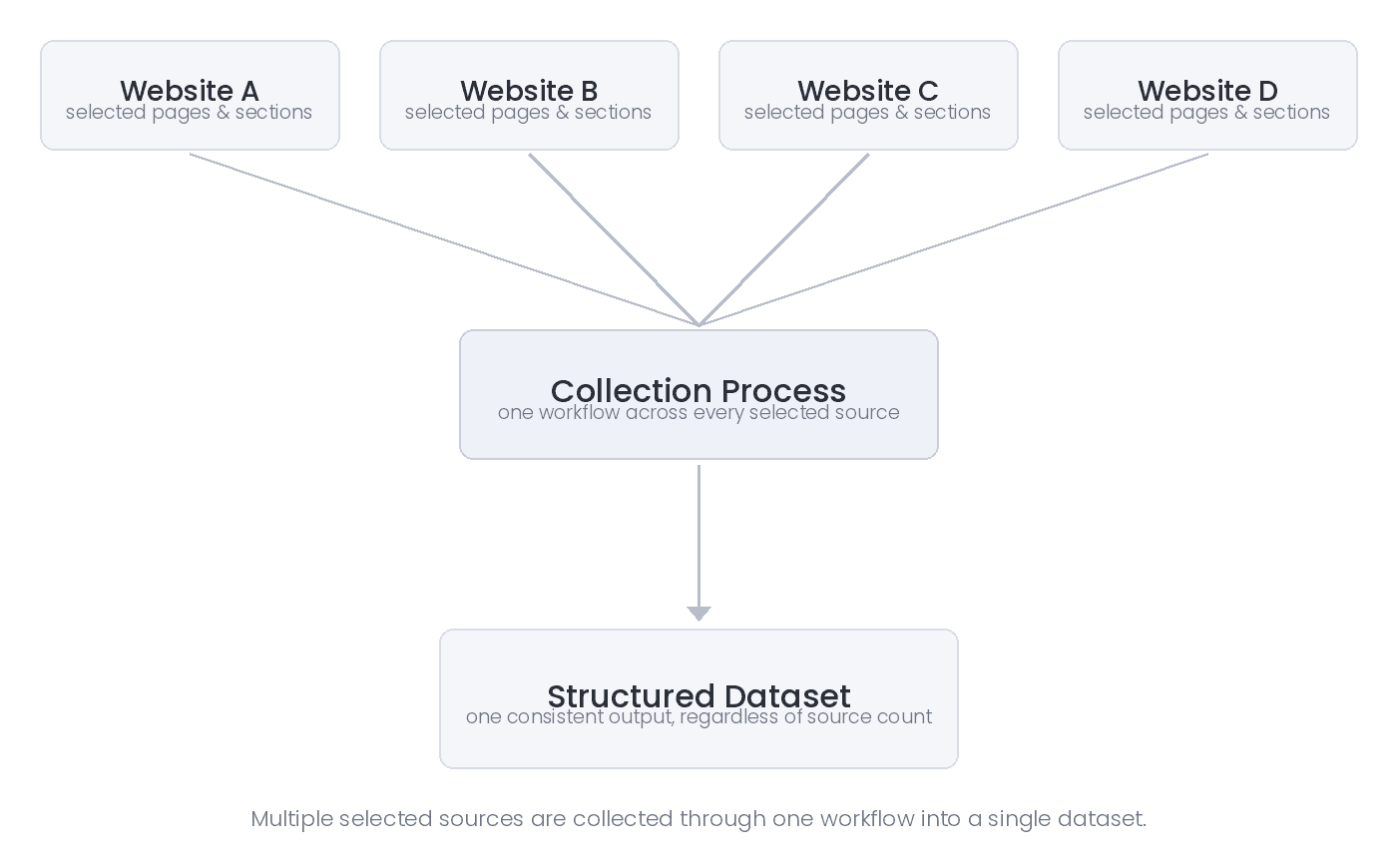
Rather than treating each source as a separate result, the information is collected into a single, consistent structure:
- The same field names and layout are used across every source
- Records from different sources sit in the same dataset, not separate files
- A source reference can be retained with each record, where relevant to the project, so it is clear which website a record came from
The result is one dataset that can be read and used the same way, regardless of how many sources it was built from.
Request a Data Collection Project
From Collection to Dataset
Collection and preparation are two different parts of a large project.
Collection is gathering the required information from the defined sources. Structuring is what turns that gathered information into one usable, consistent dataset once collection is complete.
This page covers the collection side of a large-scale project. Preparing and cleaning a collected dataset in more detail is a separate part of the work.
One-Time and Recurring Large-Scale Collection
Projects vary in whether they need a large dataset once, or the same large collection repeated over time.
One-Time Large-Scale Collection
A one-time large-scale project provides a fixed, broad dataset for a specific research, analysis, database or reporting need. Common applications include:
- Large-scale market research datasets
- Creation of large product or listing catalogs
- Creation of large business databases
- Directory compilation across many sources
- Analysis datasets drawn from many pages or sources
Recurring Large-Scale Collection
Recurring large-scale collection means repeating the same broad collection again on a defined schedule, rather than collecting it once.
The frequency, sources, fields and delivery method of a recurring large-scale project can be defined around the requirements of the project.
Example Large-Scale Collection Structure
A large-scale project can be pictured as a flow: from a number of selected sources, through the pages or sections that matter within them, into a single collection process, and out as one structured dataset.
When Large-Scale Collection Is the Main Requirement
Large-scale collection fits when the requirement looks like:
- Collecting from many pages or many websites, where breadth is the main driver
- Combining several sources into one consistent dataset
- Building a broad dataset intended for internal use, such as a database or reporting system
- Repeating a large collection on a schedule, rather than a single defined pull
Define the Data Collection Project
A large-scale project is defined around a few things:
- The sources or scope involved
- The approximate breadth of the collection
- The fields needed from every source
- Whether the project is one-time or needs to repeat
- The output format you need
Output can be delivered as CSV, Excel, JSON, database-ready data, or API access, where applicable to the project.
Send over what you know about the sources and scope, and we can work out the rest from there.
Request a Data Collection Project