

News & Content Data From Defined Sources
News websites, publishers, blogs, and magazines carry structured information alongside their articles: headlines, authors, dates, categories, and more. A project can focus on the sources and fields defined for your requirement, rather than treating online content as one undifferentiated stream.
Where information is publicly displayed, it can be collected from selected sources and organized into the fields your project needs.
Request a Data Collection Project
What News & Content Data Can Be Collected
Depending on the source and project requirements, content data can include:
- Source or publisher
- Headline or title
- Author, where displayed
- Published date, where displayed
- Category
- Tags
- Summary or excerpt
- Article or content body, where permitted and required
- Image information, where required and permitted
- Source URL or article URL
Which fields are available depends on what a given source publishes.
Article Data as Structured Records
Each article or content item can be represented as one record, with fields kept in the same place across every item collected. The value is in the consistency: source, title, author, date, category, tags, and content sitting in the same fields every time. That structure is what makes a batch of articles comparable rather than a pile of separate pages.
Different Types of Online Content
Where supported by the source, the kinds of content a project can cover include:
- News articles
- Publisher content
- Blog posts
- Magazine or editorial content
- Other selected online content
Key Content Elements
Headline & Source Information
Headline, publisher, and article URL, as displayed alongside the content.
Author & Publication Date
Author and publication date, where a source displays them.
Categories & Tags
Category, subcategory, and tags used to classify a piece of content on its source site.
Article Content
Body content, where permitted and required for the project, alongside the summary or excerpt a source displays.
Images & URLs
Image information, where required and permitted, along with the source or article URL for each item.
Collecting Content From Multiple Sources
A project may involve more than one defined publisher, website, or content source at once. Where that’s the case, the requested fields can be organized consistently across those sources.
Not every publisher structures its pages the same way, so how closely two sources line up in the final dataset depends on what each one actually publishes.
One-Time and Recurring Content Collection
One-Time Collection
A single collection fits projects that need a defined dataset at one point in time. Common examples include:
- News research
- Article collection
- Publisher research
- Content research
- Media or content analysis
Recurring Collection
Where new content needs to be picked up over time, the same sources and fields are revisited according to the schedule defined for the project, rather than as a single pull.
From Content Sources to Structured Data
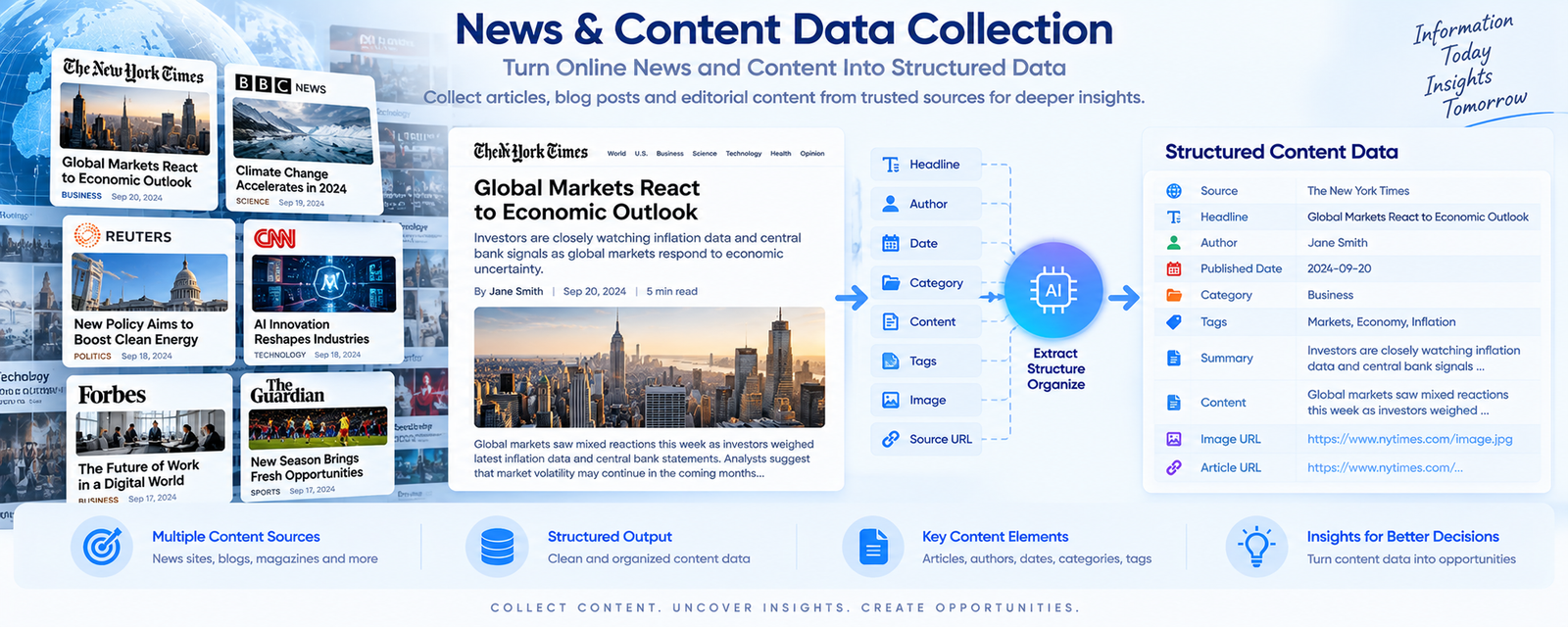
A single article or content page can carry a number of separate information elements at once. The illustration below shows the types of fields that can be pulled from a page like that and organized into structured content data. The publisher names, titles, authors, dates, categories, tags, and text shown are illustrative examples used to demonstrate the kind of data involved, not verified or current news content.
News & Content Data for Different Requirements
This type of project tends to support requirements such as:
- News research
- Media research
- Article databases
- Content research
- Publisher research
- Selected market or content research
Define the Content Data You Need
Before scoping the work, it helps to define:
- Target publishers or websites
- Content categories
- Required fields
- Geographic or topic scope, where applicable
- Whether the need is one-time or recurring
- Preferred output format
- Any source-specific requirements
Once these are defined, we can review the requirement and confirm an approach for the project.
Request a Data Collection Project