

How to Collect Product Data from Multiple Ecommerce Websites
Online stores contain a large amount of useful product information, including product names, descriptions, prices, categories, images, specifications, and availability. For businesses that need to research products across multiple online stores, collecting this information manually can become a time-consuming task.
Whether you operate an online retail business, manage a product comparison website, conduct market research, or analyze competitor offerings, having access to organized product information can support better business decisions.
To collect product data from ecommerce websites helps businesses bring information from different online sources into a centralized dataset. Instead of checking individual product pages one by one, businesses can use structured data collection processes to gather the required information in a consistent format.
In this guide, we will explain what ecommerce product data collection involves, what information can be collected, how the process works, and how businesses can use the collected data.
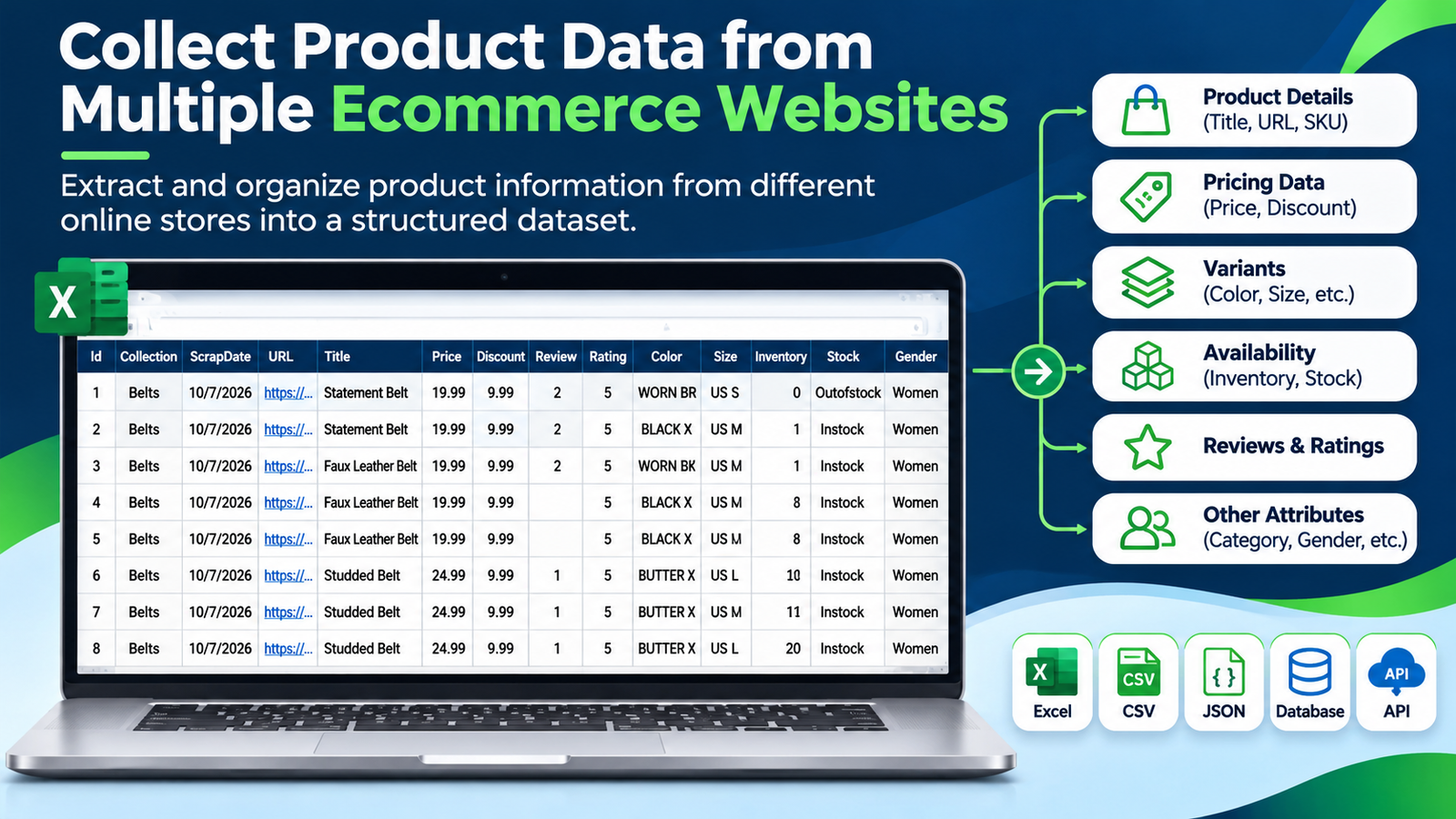
What Is Ecommerce Product Data Collection?
Ecommerce product data collection is the process of gathering product-related information from online stores, retail websites, and marketplaces.
The collected information can include product names, descriptions, prices, brands, categories, images, specifications, product identifiers, and publicly displayed availability details.
When businesses need information from multiple online stores, collecting it manually can be difficult. Each website may have a different page structure, product layout, naming convention, and presentation of information.
A structured data collection process helps organize information from different sources into a consistent dataset.
For example, a business researching a particular product category may want to collect:
- Product name and description
- Brand and manufacturer
- Product category
- Regular and discounted prices
- Product images
- SKU or product identifier, where displayed
- Product specifications
- Available colors, sizes, and variants
- Displayed stock or availability status
- Product page URL
The exact information depends on the source website and the requirements of the project. For more understanding watch video on Ecommerce data scraping.
Why Do Businesses Collect Product Data from Multiple Ecommerce Websites?
Businesses collect product information from different online sources for several operational and research purposes.
1. Competitor Product Research
Understanding what competitors offer can help businesses evaluate their product assortment and market positioning.
By collecting publicly displayed product information from selected online stores, businesses can compare:
- Product names and categories
- Brands and manufacturers
- Product specifications
- Displayed prices
- Discounts and promotions
- Product availability
- Product variations
This information can help businesses identify differences in product offerings and understand how competing retailers present their catalogs.
2. Product Price Comparison
Product prices can vary across online stores. Businesses that sell similar products may need to compare displayed prices across different sources.
A structured product dataset can help organize:
- Product name
- Product URL
- Brand
- Regular price
- Discounted price
- Currency
- Displayed discount
- Collection date
This information can support price comparison research and help businesses understand pricing differences across selected retailers. Price scraping services help a lot for businesses to improve profits.
3. Product Catalog Management
Retail businesses often manage large product catalogs containing thousands of items.
When product information is collected from multiple sources, businesses may need to combine it into a centralized catalog.
Product data collection can help gather information such as:
- Product titles
- Descriptions
- Categories
- Images
- Specifications
- Brand names
- Product identifiers
- Product variants
A centralized dataset makes product information easier to review, compare, organize, and process.
4. Market Research
Product information can provide useful insights into the products available within a particular market or category.
Businesses can collect product details from selected online sources to study:
- Popular product categories
- Brand availability
- Product variety
- Pricing differences
- Product specifications
- Promotional offers
- New product listings
This information can support market research and product planning activities.
5. Product Comparison Websites
Price comparison and product discovery platforms need structured product information from multiple retailers.
Collected data can help these platforms organize similar products and present their details in a consistent format.
For example, a comparison platform may display the same product across several retailers with information such as product name, price, image, seller, and product URL.
Accurate product matching is important because the same product may be listed using different titles or descriptions on different websites.
What Product Data Can Be Collected from Ecommerce Websites?
The required data fields depend on the website, product category, and business objective. A customized collection process can include several types of product information.
1. Basic Product Information
Basic product information identifies each product and provides its main details.
Common fields include:
- Product name
- Product title
- Product URL
- Product ID
- SKU, where displayed
- Brand name
- Manufacturer
- Product category
- Subcategory
- Product description
2. Product Pricing Information
Pricing information is useful for product comparison, competitor research, and retail market analysis.
Depending on the source, collected fields may include:
- Regular price
- Sale price
- Discounted price
- Maximum retail price, where displayed
- Discount percentage
- Currency
- Unit price, where available
- Promotional price
3. Product Images and Media
Product images help businesses identify products and maintain visual product catalogs.
Possible fields include:
- Main product image URL
- Additional image URLs
- Product thumbnail
- Image gallery URLs
- Product video URL, where publicly displayed
4. Product Specifications
Specifications provide additional information about product features and characteristics.
Examples include:
- Product dimensions
- Weight
- Material
- Color
- Size
- Technical specifications
- Model number
- Product attributes
- Packaging information
The available fields will vary according to the product category.
5. Product Variants
Some products are available in multiple variations.
For example, clothing products may have different sizes and colors, while electronic products may have different storage capacities or configurations.
Variant-related information can include:
- Variant name
- Size
- Color
- Model
- Configuration
- Variant-specific price
- Variant-specific availability
6. Product Availability
Businesses may also need to understand whether products are displayed as available or unavailable.
Depending on what the source publicly displays, collected information can include:
- In-stock status
- Out-of-stock status
- Availability message
- Product listing status
- Estimated delivery information, where displayed
Actual inventory quantities should not be assumed unless the website explicitly displays them.
7. Ratings and Customer Reviews
Publicly displayed product ratings and reviews can provide additional information for product research.
Depending on the source, fields may include:
- Average product rating
- Total review count
- Review title
- Review text
- Review date
How to Collect Product Data from Ecommerce Websites
The process of collecting product information depends on the number of websites, the amount of data, and the required fields.
A typical workflow involves the following steps.
Step 1: Identify the Ecommerce Websites
First, identify the online stores and product sources from which you need information.
The sources may include:
- Online retail stores
- Brand-owned online stores
- Multi-vendor marketplaces
- Niche ecommerce websites
- Industry-specific online stores
Prepare a list of website URLs, product category pages, or specific product pages.
Defining the sources in advance helps establish the scope of the data collection project.
Step 2: Define the Required Product Fields
Different businesses need different product information.
For example, a price comparison website may primarily need product names, prices, images, and URLs. A market research company may also require categories, specifications, brands, and product variants.
Prepare a list of the fields you want to collect.
A sample field structure could look like this:
| Field | Description |
|---|---|
| Product Name | Displayed product title |
| Brand | Product brand |
| Category | Product category |
| Price | Current displayed price |
| Original Price | Original or regular price, where displayed |
| Discount | Displayed discount |
| SKU | Product identifier, where available |
| Image URL | Main product image |
| Product URL | Product page address |
| Availability | Displayed availability status |
| Rating | Average displayed rating |
Step 3: Understand the Website Structure
Different ecommerce websites organize their product information differently.
Some websites display product details directly in HTML, while others load information dynamically or provide structured data through publicly accessible interfaces.
Understanding the website structure helps determine the appropriate data collection approach.
The process may involve reviewing:
- Product listing pages
- Product detail pages
- Category pages
- Pagination
- Product variants
- Publicly accessible structured data
- Website-specific data structures
The collection method should be selected according to the source structure and permitted access conditions.
Step 4: Extract Product Information
Once the source structure and required fields are defined, the collection process can begin.
Product information may be collected from selected listing pages, product detail pages, and other relevant publicly accessible source pages.
For larger projects, automated product data extraction can help process many product URLs and categories without manually opening every page.
The extraction process should follow the defined field requirements and avoid collecting information outside the approved project scope.
Step 5: Combine Data from Multiple Sources
When collecting information from different websites, the output may contain inconsistent field names, formats, and product descriptions.
For example, one source may use the field name “Product Title,” while another uses “Product Name.”
These fields can be mapped to a common structure so that the information is easier to compare and analyze.
Step 6: Clean and Standardize the Data
Data cleaning is an important part of preparing product information for business use.
Common data preparation activities include:
- Removing duplicate records
- Standardizing field names
- Normalizing price formats
- Organizing product categories
- Formatting product attributes
- Checking missing values
- Validating product URLs
- Standardizing brand names
- Organizing product variants
Product matching may also be required when the same product appears across different websites with different titles or descriptions.
Step 7: Export the Collected Data
After extraction and data preparation, the final dataset can be delivered in a suitable format.
Common formats include:
- CSV
- Excel
- JSON
- Database
- API
The appropriate format depends on how the business plans to use the information.
Challenges of Collecting Product Data from Multiple Ecommerce Websites
Although product data collection can provide valuable information, working with multiple websites introduces several challenges.
Different Website Structures
Every ecommerce website may use a different layout and structure.
Product titles, prices, images, specifications, and variants may appear in different sections of the page.
A collection process must account for these differences.
Dynamic Product Information
Some websites load product details dynamically.
Information such as prices, availability, product variations, and ratings may appear after the initial page loads.
The extraction workflow must be suitable for the way the source presents its information.
Inconsistent Product Information
The same product may have different titles, descriptions, or category names across multiple websites.
Without standardization, comparing these records can become difficult.
Product Matching and Duplicate Records
A product may appear more than once across different sources or categories.
Businesses may need to identify matching products using attributes such as brand, model number, SKU, product identifiers, and specifications.
Changes in Website Structure
Online stores regularly update their page layouts and data structures.
These changes can affect existing collection workflows and may require adjustments to maintain data quality.
Large Product Catalogs
Collecting product information from thousands of product pages requires proper planning.
The project needs to consider source coverage, collection volume, update frequency, data processing, and output requirements.
How Businesses Can Use Collected Ecommerce Product Data
Once product information has been collected and organized, businesses can use it in different ways.
Retail Price Analysis
Retailers can compare product prices across selected sources and study pricing differences.
Competitor Assortment Analysis
Businesses can examine product categories, brands, and product variations offered by competing retailers.
Product Comparison Platforms
Structured product records can support product comparison websites and applications.
Market Research
Researchers can organize product information to study category trends, pricing patterns, and product availability.
Product Catalog Enrichment
Businesses can use collected product information to supplement their existing catalogs with additional descriptions, specifications, images, and attributes.
Business Intelligence
Structured product datasets can be integrated into internal dashboards, reporting systems, and analytical workflows.
Why Choose a Professional Ecommerce Data Collection Service?
Collecting product information from multiple ecommerce websites can require technical knowledge, source-specific extraction methods, data processing, and ongoing maintenance.
A professional data collection service can help businesses manage these activities according to their requirements.
Worth Web Scraping provides customized ecommerce data collection solutions based on selected websites, required product fields, data volume, and delivery preferences.
Our approach can include:
- Collection from selected ecommerce websites
- Product information extraction
- Product pricing data collection
- Product category and specification extraction
- Product image URL collection
- Product variant information
- Publicly displayed availability information
- Data cleaning and standardization
- Duplicate identification
- Structured data delivery
Each project is planned according to the source websites and the information required by the client.
You can learn more about our Ecommerce Data Scraping Services and discuss your product data collection requirements with our team.
What Formats Are Available for Ecommerce Product Data?
The collected product information can be organized according to your business workflow.
CSV
CSV files are suitable for structured product records and can be imported into many spreadsheet and data processing applications.
Excel
Excel is useful for reviewing, filtering, sorting, and analyzing product information.
JSON
JSON is suitable for applications that need structured records and nested product attributes.
Database
Product datasets can be prepared for integration into supported database systems.
API
For projects that require integration with other applications, an API-based delivery approach can be discussed according to the technical requirements.
Frequently Asked Questions
1. What is ecommerce product data collection?
Ecommerce product data collection is the process of gathering product-related information from online stores and marketplaces. It may include product names, prices, descriptions, categories, images, specifications, variants, and publicly displayed availability.
2. What information can be collected from ecommerce websites?
Depending on the source, information may include product titles, brand names, categories, descriptions, prices, discounts, SKUs, images, specifications, variants, ratings, and availability details.
3. Can product data be collected from multiple ecommerce websites?
Yes. A customized data collection workflow can be designed to collect selected product information from multiple websites and organize it into a common dataset.
4. Can product prices be collected from online stores?
Publicly displayed product prices can be included in a data collection project. Depending on the source, fields may include regular prices, discounted prices, currencies, and promotional information.
5. Can product images be collected?
Publicly displayed product image URLs can be collected where available and included in the structured dataset.
6. Can product variations be extracted?
Depending on how the website presents product variants, information such as size, color, model, and configuration can be included in the collection requirements.
7. How is product data delivered?
Product information can be prepared in CSV, Excel, JSON, database, or API-based formats, depending on project requirements.
8. Can ecommerce product data be collected regularly?
Yes. Recurring collection can be planned for projects that require periodic updates to selected product information.
9. How do you handle duplicate product records?
Duplicate identification can be included in the data cleaning process. Product identifiers, SKUs, brand names, model numbers, and specifications may help identify matching records.
10. Is ecommerce product data collection customizable?
Yes. The project can be customized according to selected websites, product categories, required fields, collection volume, frequency, and output format.
Conclusion
Collecting product data from multiple ecommerce websites can help businesses organize product information, compare retail offerings, research competitors, and support product catalog management.
However, gathering information from different online sources requires more than simply collecting product titles and prices. Website structures, product attributes, variants, pricing formats, and data quality all need to be considered.
A structured ecommerce product data collection process helps transform information from multiple sources into a consistent dataset that businesses can use for research, comparison, reporting, and internal applications.
If your business needs product information from multiple online stores, a customized data collection solution can help you gather and organize the required information.
Need Product Data from Multiple Ecommerce Websites?
Worth Web Scraping offers customized ecommerce data collection solutions based on your selected websites, product categories, required data fields, and delivery format.
Whether you need a one-time product dataset or recurring product information updates, we can review your requirements and suggest a suitable approach.
Explore Our Ecommerce Data Scraping Services
Contact our team to discuss your product data collection project.