

How to Scrape Black Friday Deals and Promotional Offers from Ecommerce Websites
Black Friday is a major promotional event for ecommerce businesses, with retailers launching different offers to attract customers and increase sales. Online stores use various promotional techniques, including discount codes, coupon offers, bundle deals, limited-time promotions, and special purchase incentives.
These promotional campaigns provide useful information for businesses interested in understanding retail marketing strategies and competitor activities. However, promotional details are often displayed across multiple website sections, including homepage banners, dedicated sale pages, product descriptions, and coupon sections.
Manually collecting this information from multiple ecommerce websites can be time-consuming. Promotional offer and coupon data scraping helps businesses automate the collection of publicly displayed promotional information and organize it into structured datasets.
With customized web scraping solutions, businesses can collect coupon codes, promotional descriptions, discount conditions, bundle offers, and campaign validity details from selected ecommerce websites.
In this article, we will explain how promotional offer and coupon data scraping works, what information businesses can collect, and how the extracted data can support Black Friday promotional research and business decisions.
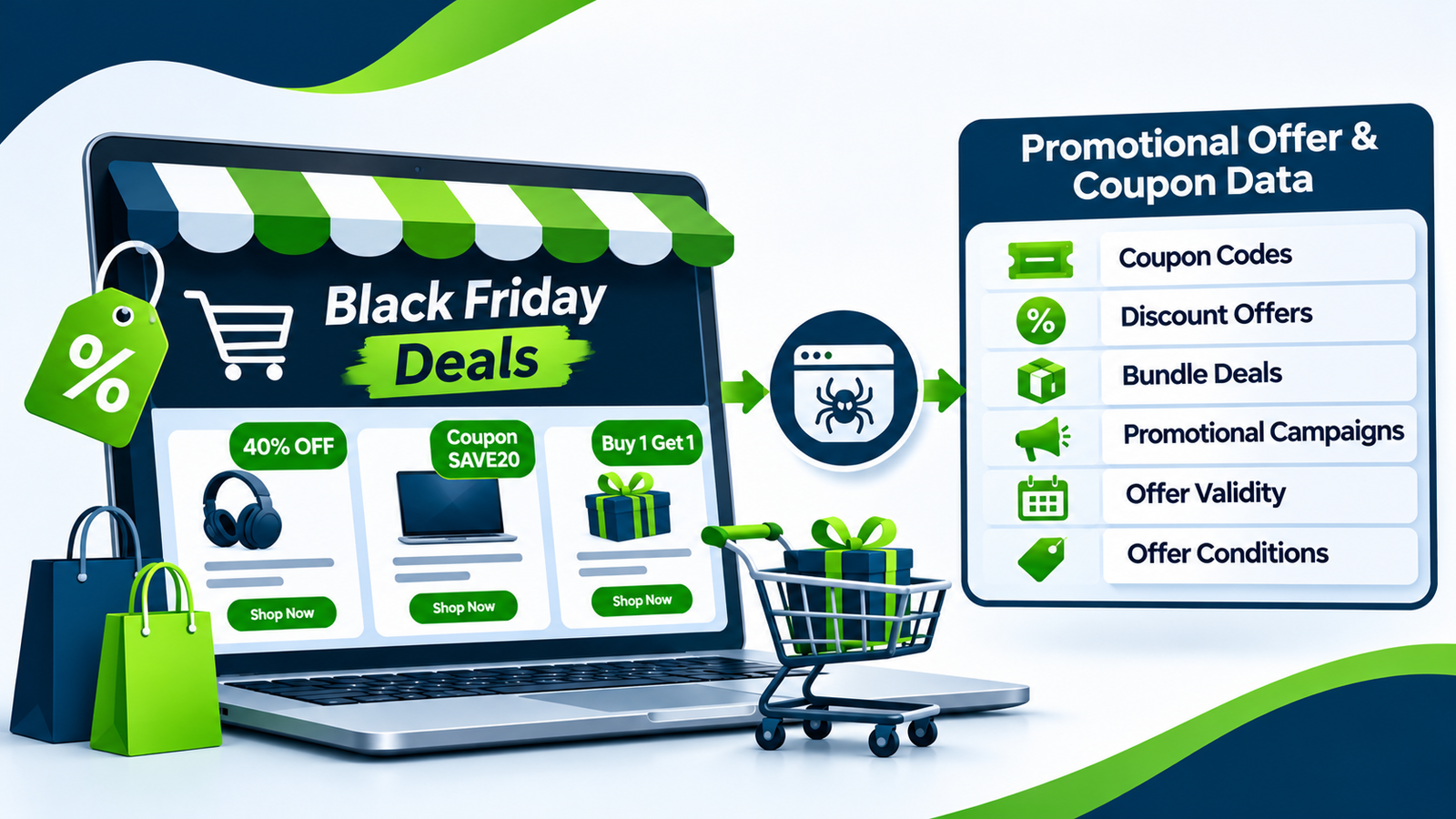
What Is Promotional Offer and Coupon Data Scraping?
Promotional offer and coupon data scraping is the process of automatically extracting publicly displayed promotional information from ecommerce websites.
Online retailers use different promotional methods to attract customers. These may include percentage discounts, fixed-value coupons, promotional codes, free shipping offers, buy-one-get-one deals, and special product bundles.
This information may appear in website banners, promotional landing pages, product descriptions, dedicated coupon sections, and other publicly accessible website content.
Using customized web scraping solutions, businesses can collect these promotional details and convert them into structured datasets for further analysis.
For example, a business may want to understand how different retailers promote their products during Black Friday. It can collect information about coupon codes, discount conditions, promotional periods, and offer types from selected ecommerce websites.
The collected information can then be organized by retailer, promotion type, product category, or campaign.
Why Is Promotional Offer and Coupon Data Important During Black Friday?
Retailers use different promotional formats during Black Friday, including percentage discounts, coupon codes, and free shipping offers. Google’s Merchant Center Promotions documentation explains how online retailers can create and manage promotional offers.
During Black Friday, ecommerce retailers introduce different promotional campaigns to attract customers. Understanding these offers can help businesses research competitor marketing activities and evaluate promotional strategies.
1. Understand Different Promotional Strategies
Retailers do not always use the same discounting approach. Some offer direct percentage discounts, while others use coupon codes, bundle deals, or minimum-purchase incentives.
Collecting promotional information helps businesses understand the different methods retailers use to communicate special offers.
2. Analyze Coupon Code Campaigns
Coupon codes are frequently used as part of ecommerce promotional campaigns.
Businesses can collect publicly displayed coupon codes and their associated conditions to understand how retailers structure additional savings and promotional incentives.
3. Compare Promotional Conditions
Two retailers may advertise similar discounts but apply different conditions.
For example, one offer may require a minimum purchase amount, while another may apply only to selected product categories.
Collecting these conditions helps businesses compare the actual structure of promotional campaigns rather than looking only at the advertised discount.
4. Research Seasonal Marketing Activities
Black Friday promotions can provide useful information about seasonal retail marketing.
Businesses can examine campaign headlines, promotional messages, offer formats, and validity periods to understand how different retailers communicate their seasonal campaigns.
What Types of Promotional and Coupon Data Can Be Collected?
The information available depends on the website and the way its promotional campaigns are presented.
A customized promotional data scraping solution can collect the following fields.
1. Coupon Codes
Coupon codes are promotional strings that customers may enter during checkout to receive a discount or another benefit.
Examples include:
- SAVE20
- BLACKFRIDAY30
- EXTRA15
- WELCOME10
Businesses can collect publicly displayed coupon codes along with the associated offer descriptions and conditions.
2. Discount Offers
Retailers may advertise different types of discounts during Black Friday.
Examples include:
- 20% off selected products
- Flat $25 discount
- Up to 50% off
- Additional 10% off using a coupon code
Collecting discount information helps businesses categorize promotional offers and compare different campaign formats.
3. Promotional Offer Types
Not all ecommerce promotions involve direct discounts. Retailers may use different offer mechanics, including:
- Buy One Get One offers
- Buy Two Get One Free
- Multi-buy discounts
- Bundle offers
- Free shipping promotions
- Gifts with purchases
- Minimum-order-value discounts
- Loyalty-based promotional offers
Identifying the offer type helps businesses understand how retailers structure their promotional campaigns.
4. Promotional Conditions
Some offers are available only when customers meet specific requirements.
Businesses can collect publicly displayed conditions such as:
- Minimum purchase amount
- Eligible product categories
- Selected product restrictions
- Coupon code requirements
- Customer eligibility conditions
- Applicable payment methods
- Offer exclusions
These details are important when comparing promotional campaigns across different retailers.
5. Promotional Validity Period
Promotional campaigns may have specific starting and ending dates.
Where displayed, businesses can collect:
- Campaign start date
- Campaign end date
- Coupon expiration date
- Limited-time offer information
- Promotional availability period
Collection timestamps can also be maintained to record when an offer was observed.
6. Promotional Banners and Campaign Descriptions
Retailers often communicate their Black Friday offers through homepage banners, category banners, and dedicated campaign pages.
Depending on the website, businesses can collect:
- Banner headlines
- Promotional descriptions
- Campaign titles
- Offer-related text
- Banner image references
- Campaign landing page URLs
This information can help businesses research promotional messaging and campaign presentation.
How to Scrape Promotional Offers and Coupon Data from Ecommerce Websites
Promotional information is displayed in different formats across ecommerce websites. A structured scraping process helps businesses collect the required information and organize it into a consistent format.
Step 1: Identify Target Ecommerce Websites
First, identify the ecommerce websites from which promotional information needs to be collected.
The selection can depend on business requirements, target markets, product categories, and competitor research objectives.
For example, a business researching electronics promotions may select online retailers that sell laptops, smartphones, televisions, and accessories.
Step 2: Identify Promotional Pages and Sections
After selecting the websites, identify the pages and sections where promotional information is displayed.
These may include:
- Black Friday campaign pages
- Homepage promotional banners
- Coupon and discount sections
- Special offers pages
- Product pages displaying coupon codes
- Category pages featuring promotional campaigns
Identifying the correct source pages helps define which promotional information should be collected.
Step 3: Extract Coupon Codes and Offer Details
The scraping process collects the required promotional information from the identified pages.
Depending on the website structure, the extraction process may collect coupon codes, discount values, promotional descriptions, offer types, and associated conditions.
Some promotional information may be available directly in page content, while other information may be loaded dynamically or embedded in promotional images. The extraction method needs to account for how each website presents its information.
Step 4: Extract Promotional Conditions and Validity
Coupon codes and promotional offers may have specific usage conditions.
Where publicly displayed, the extraction process can collect minimum purchase requirements, eligible categories, expiration dates, and other offer restrictions.
Keeping these details alongside the coupon code helps businesses understand the complete promotional offer.
Step 5: Clean and Standardize the Collected Data
Different ecommerce websites may display promotional information in different formats.
For example, one retailer may display “20% OFF,” while another may write “Save 20% on selected items.”
The collected information can be standardized into consistent fields such as promotion type, discount value, coupon code, conditions, and validity period.
This process may also include removing duplicate records and organizing promotional information by retailer and campaign.
Step 6: Validate Promotional Information
Promotional details can change during an active campaign. Coupon codes may expire, offer conditions may be updated, and campaign banners may be replaced.
Businesses should validate collected information against its source page and maintain collection timestamps.
A coupon code displayed on a website should not automatically be treated as successfully redeemable. Actual redemption may depend on customer eligibility, cart contents, location, and checkout conditions.
Step 7: Deliver Structured Promotional Data
After extraction, cleaning, and validation, the promotional information can be organized into structured datasets.
Depending on project requirements, the data can be delivered in formats such as:
- Excel
- CSV
- JSON
- Database records
- Customized data feeds
Businesses can use these datasets for promotional research, coupon analysis, and ecommerce marketing intelligence.
Example of Structured Promotional and Coupon Data
The following example shows how promotional information can be organized after extraction.
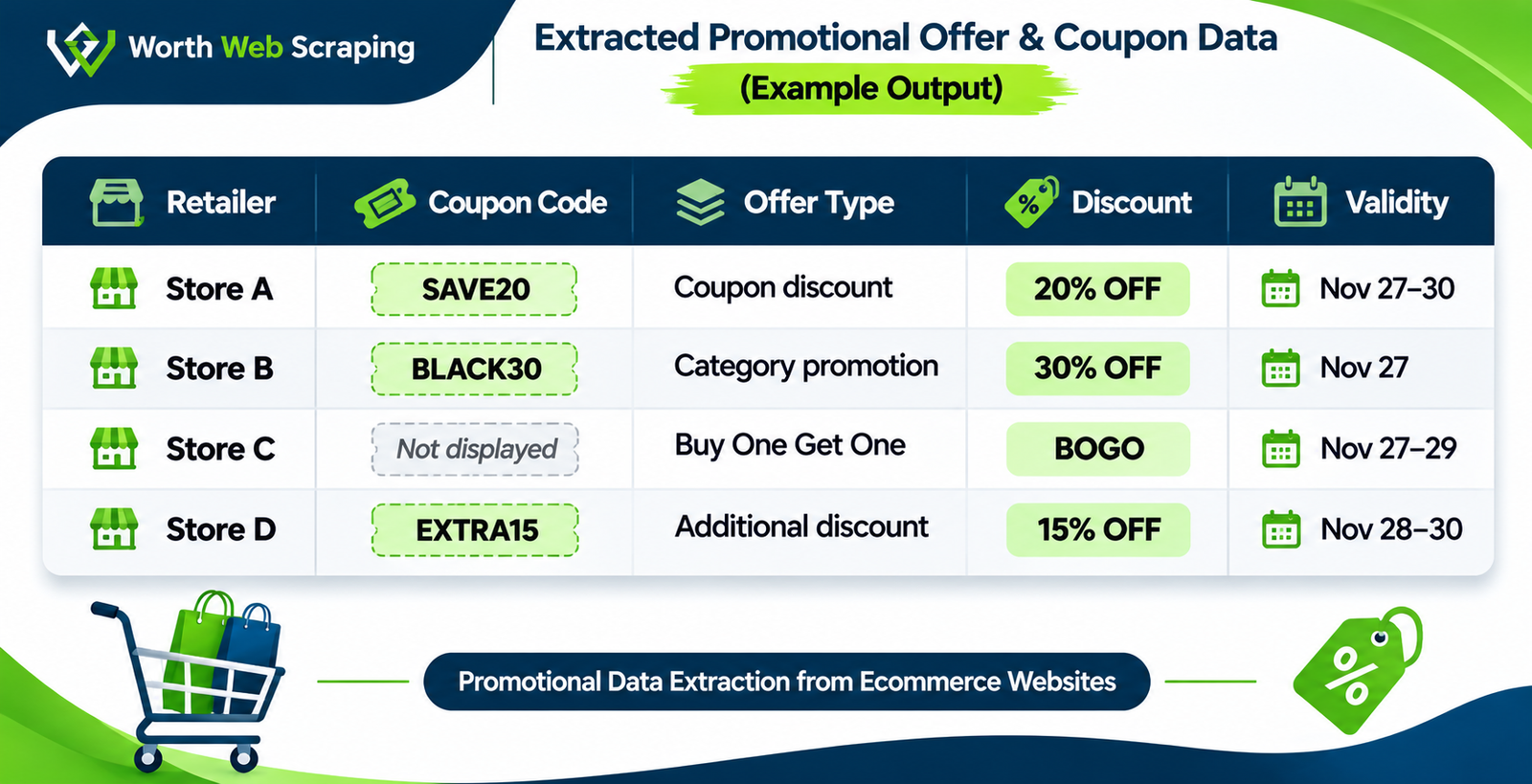
| Retailer | Coupon code | Offer type | Discount | Validity |
|---|---|---|---|---|
| Store A | SAVE20 | Coupon discount | 20% OFF | Nov 27–30 |
| Store B | BLACK30 | Category promotion | 30% OFF | Nov 27 |
| Store C | Not displayed | Buy One Get One | BOGO | Nov 27–29 |
| Store D | EXTRA15 | Additional discount | 15% OFF | Nov 28–30 |
A structured dataset makes it easier to compare promotional formats, coupon conditions, and campaign periods across different ecommerce websites.
How Businesses Can Use Promotional Offer and Coupon Data
Collecting promotional information is useful when businesses want to understand how retailers organize and communicate their campaigns.
1. Competitor Promotion Analysis
Businesses can compare promotional offers advertised by different retailers.
For example, they can examine whether competitors are using coupon codes, direct discounts, free shipping, or product bundles during Black Friday.
2. Coupon Campaign Research
Coupon information can help businesses understand how different retailers structure promotional codes and associated purchase conditions.
This can support research into coupon-based marketing strategies.
3. Retail Marketing Intelligence
Businesses can study promotional headlines, banner messages, campaign formats, and offer conditions to understand different retail marketing approaches. By combining promotional data extraction with Brand Monitoring Services, businesses can also monitor how their products and brands are represented across different ecommerce websites during Black Friday campaigns.
4. Promotional Category Analysis
Collected offers can be grouped by product category, such as electronics, fashion, beauty, home appliances, and furniture.
This allows businesses to research which promotional formats are being used across different retail categories.
5. Seasonal Campaign Planning
Businesses can use collected promotional information as an input when planning their own seasonal campaigns.
Understanding how other retailers communicate offers can help marketing teams evaluate different promotional approaches.
Challenges in Promotional Offer and Coupon Data Scraping
Although automated scraping simplifies promotional data collection, businesses may encounter several challenges.
Different Website Structures
Each ecommerce website may display coupon codes, promotional banners, and offer conditions differently. Customized extraction approaches may be required for different sources.
Dynamic Promotional Content
Some websites load promotional information dynamically using JavaScript or other technologies. The extraction process needs to account for how this content becomes available.
Promotional Information Embedded in Images
Some coupon codes and promotional details may appear inside banner images rather than ordinary page text. Image-based extraction techniques may be required where appropriate.
Frequently Changing Offers
Black Friday campaigns can be updated during the promotional period. Businesses need suitable collection schedules to capture relevant changes.
Coupon Code Validation
Collecting a coupon code does not guarantee that it will work for every customer or order. Its conditions, eligibility requirements, and expiration information need to be considered.
Data Standardization
Retailers may describe similar offers using different wording. Standardizing offer types and conditions is important for meaningful comparison.
A properly designed extraction process should respect website terms, access restrictions, and applicable laws.
How Worth Web Scraping Helps Businesses Collect Promotional Data
Worth Web Scraping provides customized web scraping solutions to help businesses collect structured information from multiple publicly accessible online sources.
For Black Friday and other seasonal promotional campaigns, businesses can use customized data extraction solutions to collect:
- Publicly displayed coupon codes
- Promotional titles and descriptions
- Discount percentages and values
- Buy One Get One and multi-buy offers
- Product bundle promotions
- Promotional conditions
- Campaign start and end dates
- Promotional banner information
- Offer-related URLs
The collected information can be cleaned, standardized, and delivered in Excel, CSV, JSON, database records, or other agreed formats.
Businesses can choose one-time data collection or scheduled extraction based on their requirements and the accessibility of the source websites.
Explore our Ecommerce Data Scraping Services to learn more about customized ecommerce data collection solutions.
Frequently Asked Questions
1. What is promotional offer and coupon data scraping?
Promotional offer and coupon data scraping is the automated collection of publicly displayed promotional information from ecommerce websites, including coupon codes, discount offers, bundle deals, and promotional conditions.
2. Can web scraping collect coupon codes from ecommerce websites?
Yes. Customized scraping solutions can collect publicly displayed coupon codes and their associated promotional information from accessible ecommerce pages.
3. What information can be collected from Black Friday promotional campaigns?
Businesses can collect coupon codes, discount values, promotional descriptions, offer types, bundle information, campaign conditions, validity periods, and related URLs, depending on the available website content.
4. Can promotional data be collected from multiple ecommerce websites?
Yes. A customized scraping process can collect promotional information from multiple selected websites and organize the results into a standardized dataset.
5. Can scraping identify expired coupon codes?
A scraping process can identify codes whose published expiration dates have passed or offers that are no longer displayed. However, confirming whether a code is redeemable may require separate validation, subject to the retailer’s permitted checkout process and offer conditions.
6. Can promotional banner information also be extracted?
Yes. Promotional text displayed on accessible website banners can be collected. If the text is embedded in an image, image-text extraction techniques may be needed.
7. Can promotional offer scraping be used outside Black Friday?
Yes. The same approach can support promotional research during Cyber Monday, Christmas sales, seasonal campaigns, clearance events, and other retail promotions.
Conclusion
Black Friday creates an active promotional environment where ecommerce retailers use coupon codes, discount offers, product bundles, and special purchase incentives to attract customers.
For businesses researching these campaigns, manually collecting promotional information from multiple online stores can be time-consuming. Promotional offer and coupon data scraping helps automate the collection of publicly displayed coupon codes, offer conditions, promotional descriptions, and campaign information.
By organizing this information into structured datasets, businesses can compare promotional formats, research coupon strategies, and gain useful insights into ecommerce marketing activities.
Looking to collect promotional offer and coupon data from multiple ecommerce websites? Contact Worth Web Scraping to discuss a customized promotional data extraction solution for your business.